
BUYER'S GUIDE AND SENTIMENT ANALYSIS
Plytix vs. Akeneo: Pricing, reviews, and why teams switch
A mid-market buyer’s guide · Updated October 2026
We log and analyze every conversation we have with prospects, partners, and customers. Between April 2017 and October 2026, Akeneo came up more than 2,200 times across 272 deals with 240 companies that compared both platforms. They ranged from three-person brands to a 500,000-SKU distributor, and they kept asking the same three questions: What will it cost for what we actually use? Can our own team run it without a developer? And who helps us when something breaks? Here’s what they told us.
HOW WE BUILT THIS REPORT
Akeneo insights: CRM notes, meetings, and call transcripts from April 2017 to October 2026 · Plytix quotes and ratings: G2 reviews and published Plytix customer stories · Privacy: names and companies withheld
Top 3 reasons companies choose Plytix
Whenever a team chose Plytix over Akeneo, it came down to the same three things: a price that fits what they actually use, a platform their own team can run, and real support after they sign.
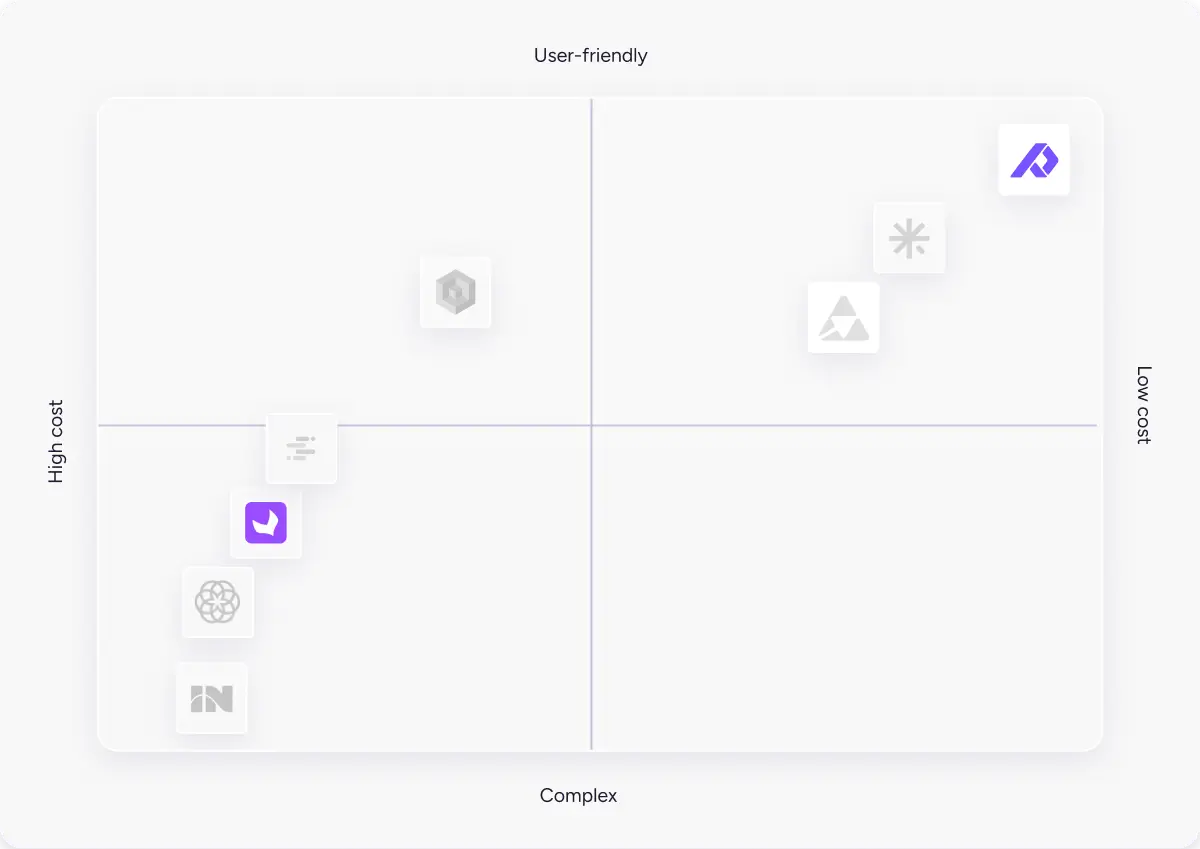
Plytix vs. Akeneo: built for very different teams
Akeneo is an enterprise PIM built for companies with complex catalogs and an IT team or implementation partner to run it, usually on a multi-year contract. Plytix is the platform mid-market brands, retailers, and distributors use to centralize, enrich, and publish their product information. You can see what it costs on our website, and your own team can run it without outside help.
When teams migrated from Akeneo to Plytix, three frustrations came up again and again.
Enterprise prices for mid-market needs
Cost came up more than any other complaint. Mid-market teams were paying for an enterprise toolkit, and much of it never made it into their day-to-day work.
AKENEO: WHAT BUYERS REPORTED
Buyers described paying enterprise rates for a platform their team only partly used, with renewals and connectors adding to the bill.
- A UK luxury-furniture retailer with about 100,000 mostly static SKUs saw its contract go up 30% at renewal and was told the answer was to “just put more products on.”
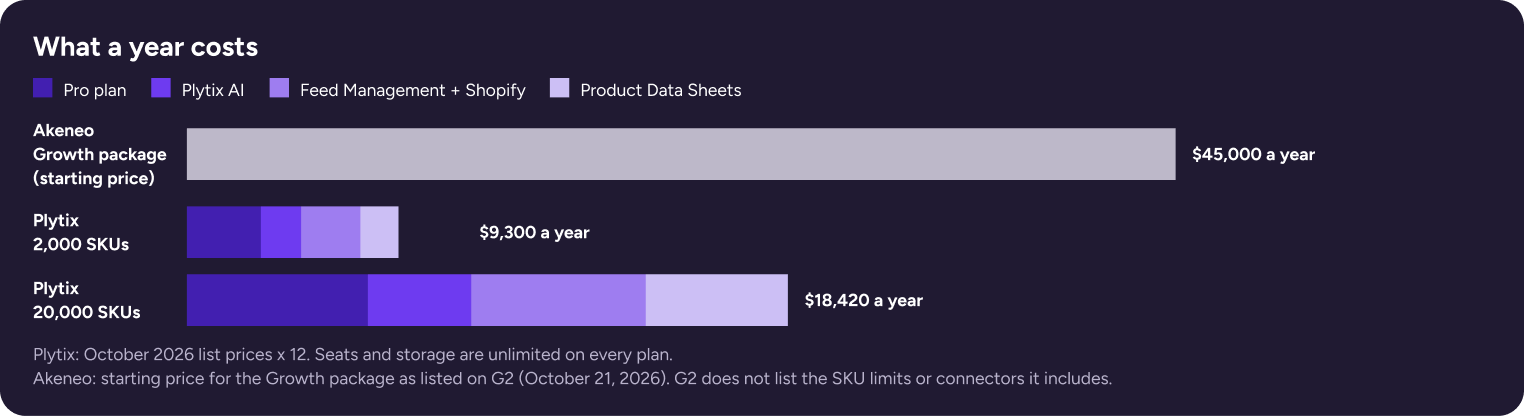
- A Canadian bike manufacturer was quoted $41,085 a year for a license it would use to refresh its catalog once a season.
- A UK nail-cosmetics brand with under 2,000 SKUs called its renewal quote plus paid Shopify and BigCommerce connectors “massive.”
“They have lots of bells and whistles, but we’re just not using them. They’re not really relevant to the way that we use Akeneo. Our last contract signing, it went up by 30%, which on top of an already really expensive PIM… we’re really just using it as a database. And I think it’s really coming down to PIMs that charge per SKU, per user, that kind of thing. It doesn’t make any sense to pay for all those extra features and things when they’re not relevant to us.”
“On top of it, we have to pay for connectors with e-commerce, connectors with Shopify. And the bill is massive. So that’s why I decided to reach out to different systems. […] Comparing your price and Akeneo’s price, it’s like a hundred percent. I would like to go with your product because the price difference is massive.”
PLYTIX: HOW IT WORKS
With Plytix, your price follows your catalog size. Add-ons like the Shopify app cover as many stores as you need, with no metering and no per-connector fees.
- Published pricing by SKU count. You see the full cost before you talk to sales.
- Unlimited seats and storage on every plan. Adding people never changes the price.
- Month to month. No multi-year contract.
“When looking for a PIM, we demoed a lot of different products. Plytix was by far the most user-friendly and cost-effective option for us.”
“Considering the price of the product, there is no other comparable price/value option on the market now. For organizations looking for a cost-effective PIM solution that combines ease of use, fast deployment, and ongoing innovation, Plytix offers tremendous value and is difficult to outperform within its price segment.”
“The bonus value for us was having channel feed management built-in for a small cost upgrade. We previously had a third party, but now this feature is rolled in and easy to manage our 15+ channel feeds including Amazon and eBay.”
Too complex for the team to run
Akeneo is a powerful PIM, but buyers said that power comes with complexity. For smaller teams, it often felt like more system than they needed.
AKENEO: WHAT BUYERS REPORTED
Buyers described a platform that everyday staff found hard to work in, with a structure that was difficult to change and outside help needed for routine work.
- A Canadian bike manufacturer built its Akeneo structure in two languages but never went live. Two of the four intended users “didn’t even want to open” it.
- A Dutch jewelry retailer with about 48,000 SKUs pays an outside consultancy to do everything in Akeneo it can’t do itself, and says a rushed implementation left the system “not so user-friendly anymore.”
- A Spanish toy distributor and a Belgian fashion wholesaler both ruled Akeneo out because setup “would require too much custom programming” and a local partner they didn’t have.
“That platform looks very easy to work with. And it’s something that we have a lot of issues with Akeneo, because for the four people that are working on the platform, we had two of them that didn’t even want to open Akeneo because they said it was too rough to work with. And I totally get it.”
“We have one party in between that is consulting us with everything, doing everything for us in Akeneo that we need, what we cannot do ourselves. They do a really good job, but they’re really too busy. I think there was too fast a transfer from the one system to the other system, and we just took things for granted, meaning that for now it’s not so user-friendly anymore.”
PLYTIX: HOW IT WORKS
With Plytix, the people who own your product data run it day to day. Plytix matches Akeneo’s ease-of-use score on G2, with more than twice as many reviewers, and rates higher for ease of setup (8.8 vs. 7.8).
- Change it yourself. Add an attribute, update a family, or adjust an export in the interface, with no ticket.
- A familiar, spreadsheet-like interface. Non-technical teams pick it up quickly.
- Unlimited seats. The whole team can work in Plytix, not just the person who set it up.
“I use this tool every day and it’s been so easy from the get-go. When we implemented, I was only the data custodian; however, as the team has changed, I’ve also been looking after the technical side, which has been very easy to learn and integrate with our existing systems.”
“We run multiple e-commerce brands and Plytix handles very different catalogs, data models, and brand requirements without making us hack around the tool. On top of that, the team actually ships, meaningful improvements land consistently, not just cosmetic updates. Most platforms in this category plateau after the sales cycle ends. Plytix keeps getting better, and we keep finding new ways to use it.”
“It was very simple to use, with lots of reference videos. A great out of the box solution with just enough customising to make work, and a great onboarding experience.”

Customer result: Universal Components
Free to license, costly to keep running
Many teams we spoke with started on Akeneo’s free Community Edition. It cost nothing to license, but keeping it running took developer time, and when something broke, there was no one to call.
AKENEO: WHAT BUYERS REPORTED
Buyers described a free product that cost them in developer time, with missing features to build, custom work to re-test after every update, and no one to call when something broke.
- A UK appliance brand ran the Community Edition for six to seven years and had to write its own modules for user permissions, image processing, exports, and an API. Every update meant re-testing all of them.
- A Canadian hot-tub retailer is still on version 2.3.5, because upgrading means it would “set up a new facility and then import the records.”
- A Belgian ecommerce company on the free edition said that when something breaks, they “ask ChatGPT and we fix it.”
“It’s a free version, so it’s quite limited in terms of import-export capabilities. It’s quite limited in terms of user management, so we have to write custom modules, custom plugins for quite a lot of things. You get access, you’re a full admin, you can do whatever you want, or you don’t get access, you see nothing. There’s no API, we had to build custom API modules. Every time there’s a freebie update version, all of our custom things need to be updated or tested or possibly reviewed and fixed.”
“We currently use Akeneo, we use the Community Edition, and we have been on that a long time. We’re on version 2.3.5, and I think the current version is 6 or 7. They’re not focusing any development or improvement on the Community Edition. The upgrade path is very cumbersome. If we were to go to either Akeneo Cloud or take the latest community version, we would have to set up a new facility and then import the records.”
PLYTIX: HOW IT WORKS
With Plytix, keeping the platform running is our job, and a named Account Manager is there when you need help. Your team’s time goes into product data, not upkeep.
- Hosted and maintained for you. Nothing to install, patch, or keep running.
- Always on the latest version. Updates roll out automatically for every customer.
- API on every plan. Connect your other systems without custom code inside the platform.
- A named Account Manager from day one.
“Overall very good PIM & DAM. We were with Akeneo and when we migrated to Plytix, everything was much easier.”
“A perfect example of an efficient affordable product to modernize your tech stack. It’s clear that the development efforts were user-centric. Very clear documentation. No need to worry about hosting or needing developers for implementation. Most importantly, one of the best support and sales experiences I had.”
“Speed and time. We now have a true PIM. Our old attribute management method was custom built, and it was slow, clunky and spread out over multiple platforms. It gets harder to maintain processes on older platforms, so getting onto a modern platform like Plytix greatly simplified how we manage attributes and product details.”

Plytix and Akeneo, side by side
What teams get with Plytix
“Plytix has allowed us to move quickly, without compromising on structure or future scalability.”
“Updating and sharing content to platforms like Shopify takes seconds. It's a total game-changer.”
Switching from Akeneo is simpler than you think
Your product data is already structured in Akeneo, so you start from organized data, not spreadsheets.