
BUYER'S GUIDE AND SENTIMENT ANALYSIS

Plytix vs. Inriver: Pricing, reviews, and why teams switch

A mid-market buyer’s guide · Updated October 2026

We log and analyze every conversation we have with prospects, partners, and customers. Between November 2015 and September 2026, Inriver came up more than 350 times across 51 deals with 43 companies that compared both platforms. Many of them were mid-market brands, distributors, or parts of larger groups paying for far more Inriver than they used. They kept asking the same three questions: What are we actually paying for? Who has to make the changes? And how does our product data get in and out? Here’s what they told us.

WHAT 350+ MENTIONS TOLD US
43
COMPANIES COMPARED BOTH
40%
HEAD-TO-HEAD WIN RATE
27%
UNKNOWN OR STILL DECIDING
60%
OF WINS WERE SWITCHERS

HOW WE BUILT THIS REPORT
Inriver insights: CRM notes, meetings, and call transcripts from November 2015 to September 2026 · Plytix quotes and ratings: G2 reviews and published Plytix customer stories · Privacy: names and companies withheld

Top 3 reasons companies choose Plytix

Whenever a team chose Plytix over Inriver, it came down to the same three things: a price that matches what the team actually uses, a platform that team can change on its own, and product data that reaches the webshop, marketplaces, and ERP without a consultant.

1. Price
With Plytix, you know what you’ll pay. Our prices are public, plans are based on your SKU count, and add-ons are clearly priced. No hidden costs or surprises when it’s time to renew.
Published pricing, unlimited seats and storage, month to month
2. Ease of use
At Plytix we build for the marketing and ecommerce people who enrich products, not just IT. Adding a field, changing a view or importing a spreadsheet is something you do yourself.
No implementation partner needed
3. Connections
With Plytix, adding a sales channel shouldn’t mean a consulting project. Connect your webshop, marketplaces, and ERP with native apps, Feed Management, and an API included in every plan.
Native Shopify and BigCommerce apps
THE COMPARISON

Plytix vs. Inriver: built for very different companies

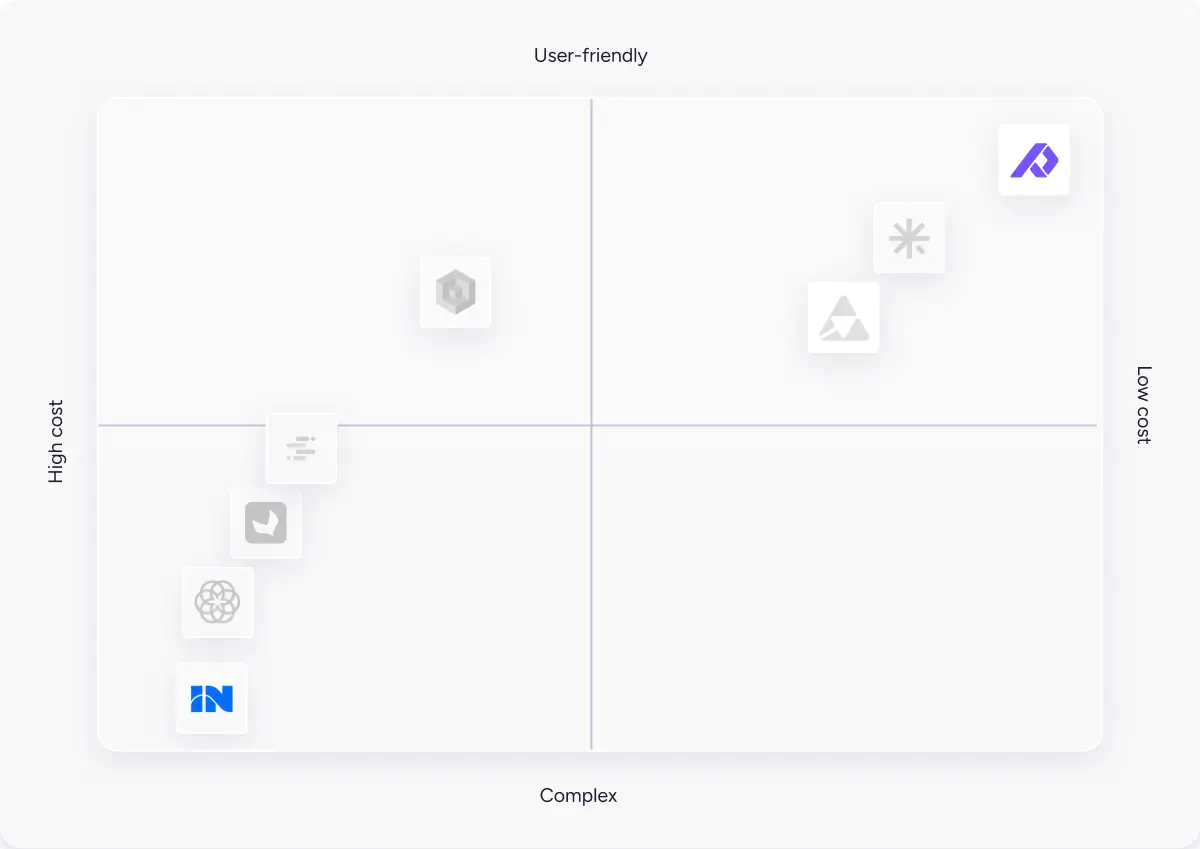
Inriver is a big system for big companies: multi-market groups that want everything customized and have a consultant on hand to do it, usually on an annual contract. Plytix is the platform mid-market brands and distributors use to centralize, enrich, and publish their product information. You can see what it costs on our website, and your own team can run it without outside help.

When teams migrated from Inriver to Plytix, three frustrations came up again and again.
#1 Paying for an enterprise license you barely use
Teams were paying an enterprise price for more platform than they needed, and the bill went up at every renewal.
#2 Too technical for the team using it
Simple changes like adding a field meant waiting on a developer or partner, and the people enriching products found the system hard to work in.
#3 Integrations that need a consultant
Every new destination, even the ERP, needed its own channel built by someone else, and long exports could fail without anyone noticing.
FRUSTRATION #1

Paying for an enterprise license you barely use

The most common complaint buyers raised about Inriver, and the trigger behind almost every switch. The product itself is rarely the problem. Teams were paying an enterprise price for a platform bigger than they needed, and that price kept climbing at renewal.

Inriver: WHAT BUYERS REPORTED

Buyers described annual licenses of tens of thousands to over a hundred thousand euros, often for far more platform than they needed. On top of that came big jumps at renewal and extra charges for AI, storage, and connectors.

  • A Canadian spa manufacturer with 63,000 SKUs was paying close to $100,000 a year for Inriver and its connectors before moving to a Plytix plan at about $13,000 a year.
  • A Swedish retail-display manufacturer with ten years on Inriver started looking elsewhere after a 25 percent price increase. A German implementation partner reported another client’s license going from €80,000 to €300,000 a year.
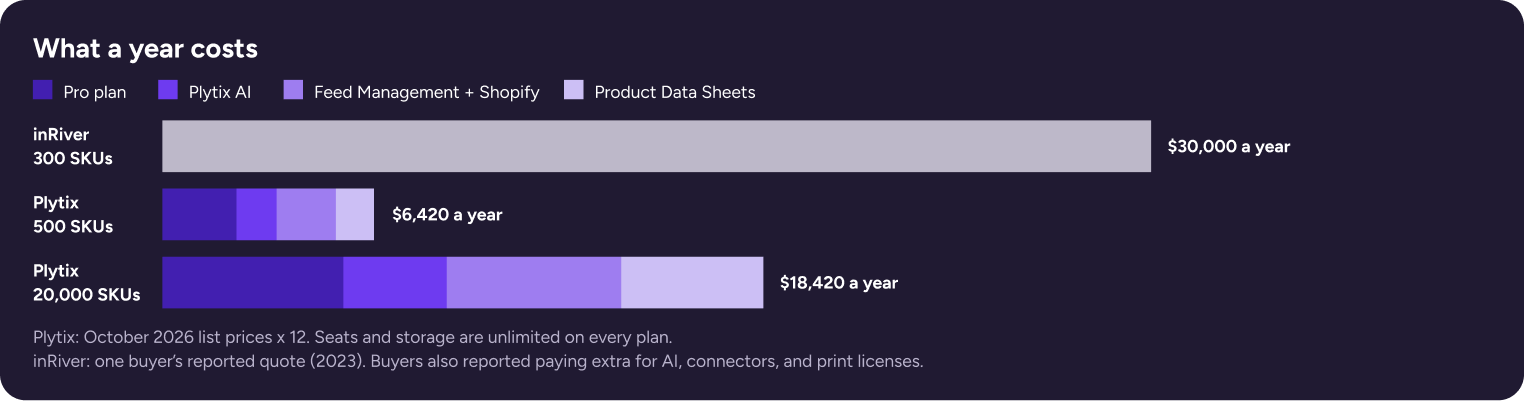
  • A 300-SKU manufacturer was quoted about $30,000 a year after its ERP vendor recommended Inriver, which it called far too much for what it needed.
IN THEIR WORDS

“We do have a PIM system today. We use it every day, but we only use one function, and that’s basically importing product info for products and then exporting. So the fee for us to use that is exponentially much higher than you are.”

Automotive accessories distributor, Sweden (2026)

“Inriver is way too expensive. It’s a good system, but nobody but GM can afford to use that any more.”

Ecommerce agency, Norway (2026)

“So in Inriver, I haven’t really used AI and it’s mainly because we also have to pay extra for it.”

Spirits and cosmetics brand, Denmark (2026)

PLYTIX: HOW IT WORKS

Plytix publishes every plan and add-on, priced by SKU count, so you can see what your team would pay before you talk to sales. Catalogs over 25,000 SKUs get a custom quote.

  • Users never change the price. Every plan comes with unlimited seats and unlimited storage.
  • Add-ons with unlimited use. Feed Management, Brand Portals, and Product Data Sheets are priced by SKU count, so one Brand Portals add-on covers as many portals as you need.
  • AI credits on every plan. Every plan includes 500 free AI credits a month.
  • Month to month, proof of concept first. Billing is month to month, and you can run a proof of concept on your own data, with every feature available, before you sign.
IN THEIR WORDS

“Plytix was by far the most user-friendly and cost-effective option for us.”

Ciara F., Director of eCommerce, mid-market, G2 review

“A perfect example of an efficient affordable product to modernize your tech stack.”

Marwan A., Growth Data Scientist, mid-market, G2 review

“On pricing, Plytix is very good value compared with enterprise PIM systems.”
Frank H., Director, Digital Systems, small business, G2 review
WHAT YOU PAY FOR AS YOU GROW
COST
Inriver (REPORTED)
Plytix
Price at renewal
25% increases reported
Month to month, no renewal
AI features
Paid add-on
500 free AI credits a month
Connectors and extras
Paid separately
Add-ons priced by SKU count
Example cost
$30,000 a year for 300 SKUs
$1,545 a month for 20,000 SKUs with four add-ons
FRUSTRATION #2

Too technical for the team using it

The second most common complaint buyers raised. Nobody doubted what Inriver can do. The problem is that it’s built for an IT team and a partner, while the people who actually enrich products work in marketing and ecommerce.

Inriver: WHAT BUYERS REPORTED

Buyers described needing developers or partners for routine changes like adding a field, an interface business users struggled with, and rules that held up publishing. Smaller teams and subsidiaries said the system was sized for a group head office, not for them.

  • An Icelandic retail group that had almost signed with Inriver chose Plytix instead. Inriver offered more features and personalization, but the project lead saw no reason to make things more complicated than they needed to be.
  • A Norwegian outdoor brand with over 100,000 SKUs said Inriver took a lot of consultants, time, and resources to fix and develop. A US sportswear maker with 100,000 SKUs said its business users always needed help from developers.
  • A Swedish battery-charger brand with about 200 products found Inriver far bigger than it needed and moved out in a matter of weeks.
IN THEIR WORDS

“I think that it’s too complex, it’s too much. It must be more simple to use and it can’t be the biggest system… it must be easy to import, to handle it without so much skills.”

Hygiene products ecommerce retailer, Sweden (2026)

“And the system’s way too complicated as well. There’s no point in trying to implement it.”

Ecommerce agency, Norway (2026)

“It was more techie on every level… you couldn’t really quite read the interface. So we didn’t really look into that one when they were looking into migrating.”

Lifestyle apparel startup, UK (2026)

PLYTIX: HOW IT WORKS

Plytix is built so your marketing and ecommerce team can run it without IT or a partner, and still get the structure a big catalog needs.

  • No implementation partner needed. We help you map your data model and configure your channels, and your team takes it from there.
  • Self-serve changes. Add an attribute, a view, or an import without opening a ticket.
  • Enterprise-grade structure. Families, Relationships, and Automations let your team model complex catalogs and set its own rules.
  • A named Account Manager. You get a named Account Manager from day one, not a partner on retainer.
IN THEIR WORDS

“One of the biggest advantages was how smoothly the rollout went. From initial setup to having our product data available in the system, the implementation was completed remarkably fast, allowing our team to start working productively almost immediately.”

Matthias R., Head of Product Management, mid-market, Capterra review

“We run multiple e-commerce brands and Plytix handles very different catalogs, data models, and brand requirements without making us hack around the tool.”

Sarah M., Senior Director, Digital Product and Experience, mid-market, Capterra review

“Having worked with numerous PIM and DAM solutions, I appreciate the User Interface of the platform as well as the ease of usability and configuration of the platform.”

Jat D., PIM Data Analyst, enterprise, Capterra review
At a Glance
Inriver (REPORTED)
Plytix
Who runs it
IT and developers
Marketing and ecommerce teams
Adding a field
Developer or partner
Your own team
Rules and workflows
Rigid, can block publishing
Automations your team controls
Product structure
Entity model set up by a partner
Families and Relationships you configure
Ease of use
7.9 out of 10
9.0 out of 10
Time to implement
7 months
3 months

Customer result: Universal Components

A UK distributor of truck and trailer parts with more than 16,000 products, where the marketing team now builds catalogs and manages product data in Plytix instead of the ERP and spreadsheets.
2x
faster time to market
Days
to build a catalog that used to take 12 months
16,000+
products in one source of truth
“The best thing about Plytix? We can finally trust our product information.”
Daniel Dixon, Marketing Manager, Universal Components. Customer story.
FRUSTRATION #3

Integrations that need a consultant

Connecting Inriver is possible, but each connection is a project. Every destination needs its own channel, often built by a consultant, and exports can run for hours and fail without anyone noticing.

Inriver: WHAT BUYERS REPORTED

Buyers described building a dedicated channel for every destination, including the ERP, plus custom extensions for the webshop and connectors they paid for separately. Long export jobs failed with no logs to show why.

  • A German intimate-apparel group listed slow performance, painful integrations, missing import and export logs, and 8- to 12-hour exports that fail without warning as its reasons for leaving Inriver.
  • A US promotional-products company with 25,000 SKUs said it couldn’t connect its on-premise Inriver to anything, and moving to the SaaS version would cost thousands of dollars it couldn’t afford.
  • A Canadian powersports parts maker whose on-premise Inriver hadn’t been updated in five or six years lost its marketplace connectors after moving from Magento to Shopify and fell back to Excel feeds.
IN THEIR WORDS

“We were using in the past Inriver. We never liked it. It was really expensive. It was an on-premise version of it, and it was complicated. The development was too expensive and everything… So all the connectors are not existing.”

Powersports parts manufacturer, Canada (2026)

“They think about it more as channels and then exporting the channel into the API. Which means, for different channels, like when you’re thinking about ERP, then you basically just have to create a dedicated channel because you want to have everything in ERP.”

Jewelry retailer, Iceland (used Inriver at a previous employer) (2026)

PLYTIX: HOW IT WORKS

Plytix gives your webshop, marketplaces, and ERP their own ready-made ways in, so adding a new destination is a setup task, not a consulting project.

  • Native apps for Shopify and BigCommerce. Sync products straight to your store with the Shopify or BigCommerce add-on.
  • Feed Management for everywhere else. Marketplaces, retailers, and distributors each get the feed format they need, with unlimited feeds on the Feed Management add-on.
  • API on every plan. Connect your ERP through the API, with webhooks on Pro and Enterprise.
  • Nothing to install. Plytix runs in the cloud, so there’s no on-premise version to maintain or fall behind on.
IN THEIR WORDS

“Using channels was a complete gamechanger for populating masterdata files for our retailers. It saved us both time and money plus decreased our time to market.”

Kasper V., E-commerce Developer and Data Analyst, mid-market, Capterra review

“Another advantage is the ability to integrate with other platforms, such as inventory management systems, which has allowed me to have better control over my stock.”

Fanny B., eCommerce Commercial Manager, mid-market, G2 review
At a Glance
Inriver (REPORTED)
Plytix
Feeds
Built per destination
Unlimited with the Feed Management add-on
ERP connection
Dedicated channel, often partner-built
API on every plan
Webshop connection
Custom extensions
Native Shopify and BigCommerce apps
Hosting
On-premise installs fall behind
Cloud-based, nothing to install

Customer result: Hagen Group

A global pet product manufacturer and distributor that tried other PIM solutions before moving its product content from team-by-team spreadsheets into Plytix.
5x
faster product updates
10+ hours
saved every week on sharing content
80%
faster product sheet creation
“Updating and sharing content to platforms like Shopify takes seconds—it’s a total game-changer.”
Arash Shahreva, Director of Systems and Process Improvement, Hagen Group. Customer story.
SUMMARY

Plytix and Inriver, side by side

CRITERIA
Inriver (REPORTED)
Plytix
Pricing model
Quote-based annual license
Published, priced by SKU count
Contract
Annual or multi-year
Month to month
User seats
Enterprise seat model
Unlimited
File storage
Contracted tiers
Unlimited
Setup
Partner-led
No implementation partner needed
Support
Mostly through partners
Named Account Manager
Product sheets and catalogs
Native InDesign plugin
Plytix Product Data Sheets (add-on)
INDEPENDENT REVIEWS
G2 CATEGORY DATA
INRIVER
PLYTIX
Star rating
4.2 (168 reviews)
4.7 (445 reviews)
Ease of use
7.9
9.0
Ease of setup
6.9
8.8
Ease of admin
7.8
9.2
Quality of support
8.0
9.7
Time to implement
7 months
3 months
Time to ROI
17 months
8 months
The side-by-side table reflects what prospects and customers told us in sales conversations from November 2015 to September 2026, and Inriver's current offering may differ. G2 data as of October 15, 2026. Inriver's implementation and ROI times are based on only nine G2 responses, compared with more than 100 for Plytix.

What changed for teams that switched

Close to $100,000 a year
paid by a Canadian spa manufacturer with 63,000 SKUs for Inriver and its connectors, replaced in 2022 by a Plytix Pro plan at about $13,000 a year.
11 days
planned for a Swedish battery-charger brand to move about 200 products, 300 attributes, and all its images out of Inriver before its contract access ended.
IN FAIRNESS
Where Inriver is a strong choice
Inriver is a strong choice for large, multi-market groups that need its deep data model, a native InDesign print workflow, and an implementation partner on site. Several buyers with hundreds of thousands of SKUs stayed with it or chose it over Plytix. Plytix is the better fit for mid-market brands and distributors whose marketing and ecommerce teams want to run the platform themselves, pay published prices, and publish to every channel without a consultant.
Switching

Switching from Inriver is simpler than you think

Your product data is already structured in Inriver, so you start from organized data, not spreadsheets. Ex-Inriver users told us the two look familiar, so attributes usually map almost one to one.

Export
Export products, attributes, assets, and categories from Inriver as CSV or XLSX files.
Map and configure
We help you map your data model and configure your channels.
Run in parallel
Operate both platforms side by side until your team is ready to switch over.

Questions buyers ask before switching

How long does it take to switch from Inriver to Plytix?
G2 reviewers report an average of three months to implement Plytix, compared with seven months for Inriver. Because product data in Inriver is already structured, attributes usually map almost one to one, and teams can run both platforms side by side until they're ready to switch over.
Can we switch to Plytix while we're still under an Inriver contract?
Yes. Plytix is billed month to month, so you can start setting up Plytix before your Inriver contract ends and switch over fully when it does.
Will our images and files transfer from Inriver to Plytix?
Yes. Images and files move into Plytix DAM along with your product data, and you can check every file before you switch Inriver off.
Is Plytix powerful enough to replace Inriver?
Yes, for most mid-market brands and distributors. Plytix handles complex product structures, multiple brands, and different data models with Families, Relationships, and Automations. It connects to other systems through an API on every plan, with webhooks on Pro and Enterprise. Inriver goes further on native InDesign print workflows and for very large multi-entity groups that want a partner on site.
How much does Inriver cost?
Inriver doesn't publish its pricing. Buyers we spoke with were on quote-based annual licenses costing tens of thousands of dollars a year, often with increases at renewal and extra charges for AI and integrations. Plytix publishes every plan and add-on on its pricing page, priced by SKU count, with unlimited seats and storage and month-to-month billing.
Is Plytix cheaper than Inriver?
For most of the teams we spoke with, yes. At 20,000 SKUs, Plytix Pro with Feed Management, Brand Portals, Product Data Sheets, and the Shopify app costs $1,545 a month (about $18,500 a year) at October 2026 list prices, with unlimited seats and storage. Inriver buyers reported paying from about $30,000 to close to $100,000 a year.
What’s the difference between Plytix and Inriver?
Inriver is built for large, multi-market enterprises, while Plytix is the product information platform built for mid-market brands and distributors. The two differ on price, ease of use, connections, and time to value. Inriver uses quote-based annual contracts, while Plytix publishes its pricing by SKU count, billed month to month. Inriver usually needs an implementation partner, while Plytix is run by your own team. Inriver needs a channel built for each destination, while Plytix connects through native apps, Feed Management, and an API on every plan. On G2, Plytix averages three months to implement, compared with seven for Inriver.
What are the best Inriver alternatives?
Teams leaving Inriver most often wanted predictable published pricing, a platform their own team could run without consultants, and reliable connections to Shopify, marketplaces, and the ERP. Many of them chose Plytix, usually timing the move to their Inriver renewal. Teams that stayed with Inriver needed its deep data model or an on-site implementation partner.

Compare both platforms on your own data

Bring your SKU count, your channels, and your next Inriver renewal date. We'll show you the same setup in Plytix, exactly what it would cost your team, and a proof of concept on your own data before you sign.
About this report. Inriver quotes come from our sales conversations from November 2015 to September 2026. Where the only record is a sales note, it has been summarized rather than quoted. Plytix customer quotes come from public G2 and Capterra reviews, and ratings from G2, as of October 15, 2026. Prices are correct as of October 2026. Inriver is a trademark of its respective owner. Plytix is not affiliated with or endorsed by Inriver. Statements about Inriver reflect experiences reported to us and may not reflect their current offering. © Plytix SLU, Málaga, Spain.