
BUYER'S GUIDE AND SENTIMENT ANALYSIS
Plytix vs. Salsify: Pricing, reviews, and why teams switch
A mid-market buyer’s guide · Updated October 2026
We log and analyze every conversation we have with prospects, partners, and customers. Between June 2017 and October 2026, Salsify came up more than 1,100 times across 194 deals with 167 companies that compared both platforms. They kept asking the same three questions: What will it cost for what we actually use? Can our own team run it? And who helps us after we sign? Here’s what they told us.
HOW WE BUILT THIS REPORT
Salsify insights: CRM notes, meetings, and call transcripts from June 2017 to October 2026 · Plytix quotes and ratings: G2 and Capterra reviews and published Plytix customer stories · Privacy: names and companies withheld
Top 3 reasons companies choose Plytix over Salsify
Whenever a team chose Plytix over Salsify, it came down to the same three things: a price that fits what they actually use, a platform their own team can run, and hands-on help getting set up.
Plytix vs. Salsify: built for very different teams
Salsify is an enterprise product experience platform built around direct syndication to retailers like Amazon, Walmart, and Home Depot. It’s usually sold on annual, quote-based contracts, with seats and modules priced separately. Plytix is the platform mid-market brands, manufacturers, and distributors use to centralize, enrich, and publish their product information, with native Shopify and BigCommerce apps and feeds for marketplaces and retailers. You can see what it costs on our website, and your own team can run it without outside help.
When teams migrated from Salsify to Plytix, three frustrations came up again and again.
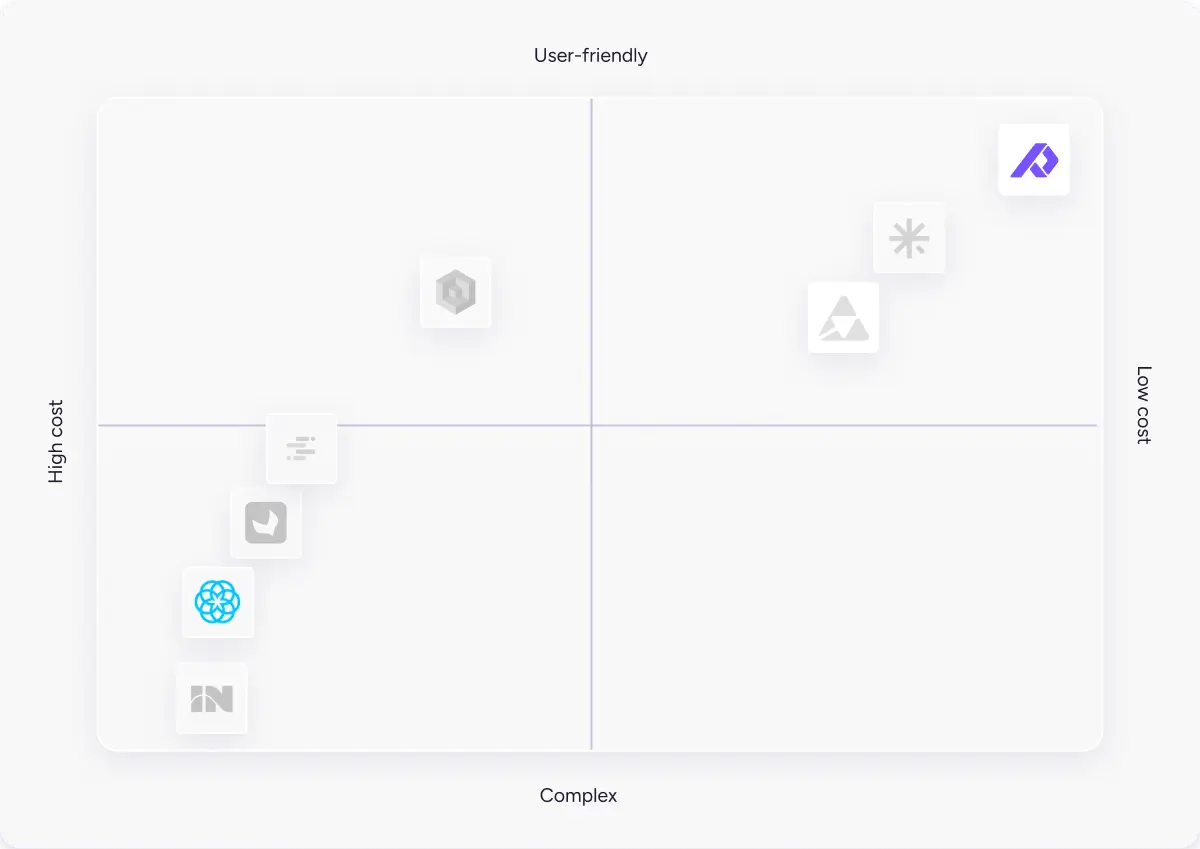
Enterprise prices for features they never used
Cost came up more than any other complaint. Buyers said the bill was built for a much bigger business, and it kept growing at renewal.
SALSIFY: WHAT BUYERS REPORTED
Buyers described bills built around seats, SKU allowances, and modules they didn’t need, with prices that rose at renewal and retailer connections that didn’t always deliver.
- A US furniture manufacturer with 1,000 to 5,000 SKUs was paying about $73,000 a year for what it called basic use.
- A US appliance brand with fewer than 700 SKUs was renewing at about $30,000 a year and was told digital catalogs would become a separately charged feature.
- A US home goods group with six brands was paying for a direct Amazon integration but still maintaining Seller Central by hand.
- A US lighting and fan manufacturer said it was promised direct Lowe’s and Home Depot integrations that never arrived.
“We are paying for a Ferrari, but we don’t need all of the fancy features that it has.”
“When I told them it’s too expensive, suddenly they came back and it came off like 50%. I don’t play games like that. … I don’t need to be spending $50,000 on an enterprise platform. It comes with no user seats, and every user seat is $1,000.”
“The current limit of our SKUs within Salsify is 50,000, which we will never reach. It’s an absurdity for us. … You feel you’re paying for a lot of things you’re not even going to use.”
PLYTIX: HOW IT WORKS
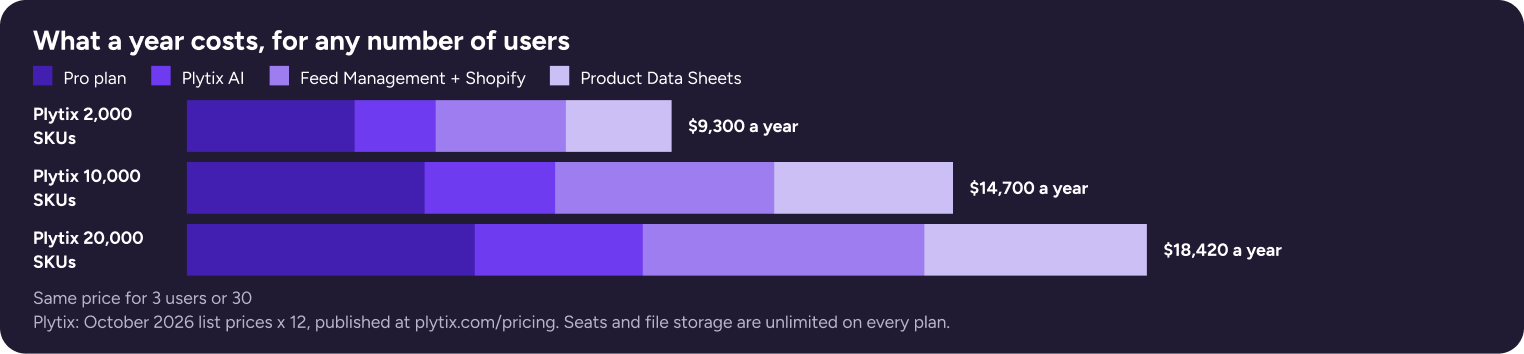
With Plytix, your price follows your catalog size, and adding people never changes it. Add-ons cover as many feeds, portals, and stores as you need, with no per-connector fees.
- Published pricing by SKU count. You see the full cost before you talk to sales.
- Unlimited seats and storage on every plan. No per-seat charges, ever.
- Month to month. No annual contract to renew.
“Compared to our old PIM/DAM platform, Salsify, Plytix is leaps and bounds better and far less expensive. The best feature is the ease of customization in their brand portals/e-catalogs. The support is fantastic, and I am in Plytix every day.”
“Plytix is an intuitive and easy to use tool that has allowed us to organize all of our ecommerce marketing content that we previously housed in multiple spreadsheets and network folders. The ability to syndicate the content to our multiple sales channels makes our lives much simpler. The upfront affordable pricing is also much appreciated compared to the much more expensive competition like Salsify.”
“Considering the price of the product, there is no other comparable price/value option on the market now. For organizations looking for a cost-effective PIM solution that combines ease of use, fast deployment, and ongoing innovation, Plytix offers tremendous value and is difficult to outperform within its price segment.”
Too complex for the team to run
Salsify is a powerful platform, but buyers said that power came with a learning curve their teams couldn’t climb. Several paid for a system only a few people could use.
SALSIFY: WHAT BUYERS REPORTED
Buyers described a platform that took specialists to run, training that didn’t stick, and implementations that dragged on or never finished.
- A US skincare brand with 500 SKUs had used Salsify for three years and was still working in spreadsheets, because it was “prohibitively technical” for the team despite extensive training.
- A US pet food maker never finished its implementation and kept working in Excel, and a US distributor spent two years implementing and “never successfully used the product.”
- A US phone-accessories company called its rollout “a failed implementation,” with little data ever making it into the PIM.
“We’ve tried to use a PIM before. It was a disaster. It was Salsify. It just kind of fell apart. It was very difficult to use. And when a company gets too big like that, working with them, I don’t like it. You’re just like a number for them.”
“Salsify is too big for us. It communicates directly to Amazon, and what we have built, we have [on] Shopify, and then we use an integrator, and from there it goes to all our marketplaces for each country.”
PLYTIX: HOW IT WORKS
With Plytix, your own team runs your product data day to day, and it still handles complex catalogs. Plytix rates 9.0 for ease of use on G2, compared with 8.4 for Salsify.
- Change it yourself. Add a field, update products in bulk, or adjust an export, with no ticket.
- Built for complex catalogs. Families, Relationships, and Automations handle variants, bundles, and rules.
- Feeds for every retailer. The Feed Management add-on builds feeds for marketplaces and retailers like Amazon, Walmart, and Home Depot from the templates they already give you.
- Unlimited seats. The whole team can work in Plytix.
“We run multiple e-commerce brands and Plytix handles very different catalogs, data models, and brand requirements without making us hack around the tool. On top of that, the team actually ships — meaningful improvements land consistently, not just cosmetic updates. Most platforms in this category plateau after the sales cycle ends. Plytix keeps getting better, and we keep finding new ways to use it.”
“Being able to upload a single CSV with product details and the content elements is so much easier instead of me having to prepare several CSVs and wait for someone else upload them. I also appreciate how easy it is to link media elements so we can be efficient and have one document or image linked to multiple products. The filters also make it easy to target the products that need improvement which is helpful when your catalog has 80,000 products.”

Customer result: Pacific Automation
Onboarding that left teams on their own
For many buyers, the hardest part of Salsify was getting started. Onboarding was light or handed to a partner, so teams were left to work out the setup themselves and never reached the value they were paying for.
SALSIFY: WHAT BUYERS REPORTED
Buyers described minimal onboarding, ticket-based support, and Account Managers who couldn’t help with technical questions, so problems took a long time to fix.
- A Canadian housewares importer renewed its license before discovering that connections it had paid for over several years had never been set up.
- Several buyers said implementation was increasingly handed to third-party integrators, with one partner quoting about $50,000.
- A US toy company said Amazon errors through Salsify got “very minimum technical support” to fix them.
“You have to figure out a couple of things yourself, like the mapping, and you feel like you’ve been left in the middle of the desert … until you write tens of emails to their customer support to help you figure it out.”
“There was really minimal onboarding. They got you in the door and then it was like, you got this, but it was way over my head. … The account manager had minimal tech experience, so it was very difficult to have quick solutions.”
PLYTIX: HOW IT WORKS
With Plytix, our team guides you through setup, and a named Account Manager stays with you long after you sign.
- Guided setup. We map your data model, bring in your products, and set up your channels with you.
- The same team after go-live. A named Account Manager from day one.
- A proof of concept on your own data, with every feature available, before you sign.
“Useful features that are always evolving and improving. It has helped our company stay organized with our many different products and brands. The implementation process is very helpful and our rep was always available if we had suggestions or questions about how to do something.”
“We looked for about 2 years before settling on Plytix. We were concerned about programs that were overly complicated and difficult to use. The Plytix team did a great job onboarding us, and we’ve really enjoyed the product. It has been one of the best things we’ve done as far as SAAS partnerships.”
“Very easy set-up, fantastic support from the account managers … and the support team. Plytix is very open about user feedback, and actually implements your suggestions if they make sense for the platform as a whole. They are a rapidly growing company, so new features are being added regularly.”

Plytix and Salsify, side by side
What teams get with Plytix
“With Plytix as a central source of truth, we can get products to market 24x faster!”
“With Plytix, we're able to share products with retail partners 3x faster. How? We swapped our spreadsheets for live feeds.”
Switching from Salsify is simpler than you think
Your product data is already structured in Salsify, so you start from organized data, not spreadsheets.