
BUYER'S GUIDE AND SENTIMENT ANALYSIS
Plytix vs. Syndigo: Pricing, reviews, and why teams switch
A mid-market buyer’s guide · Updated October 2026
We log and analyze every conversation we have with prospects, partners, and customers. Between June 2019 and October 2026, Syndigo came up more than 200 times in conversations with 108 companies, across 57 deals. They kept asking the same three questions: What will it cost for our catalog? Can our own team run it? And can we enter our data once and send it everywhere? Here’s what they told us.
HOW WE BUILT THIS REPORT
Syndigo insights: CRM notes, meetings, and call transcripts from June 2019 to October 2026 · Plytix quotes and ratings: G2 and Capterra reviews and published Plytix customer stories · Privacy: names and companies withheld
Top 3 reasons companies choose Plytix over Syndigo
Whenever a team chose Plytix over Syndigo, it came down to the same three things: a price they can see, a platform their own team can run, and product data they enter once and share everywhere.
Plytix vs. Syndigo: built for very different jobs
Plytix and Syndigo are built for entirely different jobs. Syndigo is fundamentally a content-syndication network first. It owns the 1WorldSync and GDSN connections that major big-box retailers require. What it does best is delivery. But a pipe can only carry what you put into it, and mid-market teams told us they found themselves treating it like a retailer-specific feed, manually re-entering the same products for every channel and struggling to make simple updates.
Plytix fixes the foundation. Built specifically for mid-market brands, Plytix gives your team a single, editable source of truth. You enter your product data once, and from there, it is accurate, complete, and ready to push to any retailer template, brand portal, or spec sheet. You get unlimited users for one published, predictable price. And when a channel does mandate GDSN, you simply connect via our feeds and partners.
When teams moved their product data from Syndigo to Plytix, three frustrations came up again and again.
Syndication prices for a mid-market catalog
Cost came up more than any other complaint. Buyers said the pricing was built for national brands, not for the size of catalog they actually had.
SYNDIGO: WHAT BUYERS REPORTED
Buyers described fees per SKU and per retailer, quotes sized for national brands, and steep increases when they went over their agreed SKU count.
- Buyers called Syndigo “pricey” and “a premium,” and one distributor with a very large catalog said it was paying “a pretty decent premium” while “not utilizing [Syndigo] to its fullest.”
- A US bakery paid $100 per SKU through a food-service distributor’s Syndigo connection to set up its items, then found it had already paid the same fee for the same items with another distributor.
- A US importer of gloves and home decor selling on Amazon and to big-box retailers was quoted about $70,000, and another buyer said that at renewal, Syndigo “started throwing numbers at me.”
“We have about 5,000 SKUs hosted right now. That’s above our agreement. And in order to keep using it, they’re asking for a very large price increase.”
“We had a call with Syndigo recently, and for 15 SKUs to syndicate the updated packaging was going to be like $15,000 to $20,000 a year, and we would love to not do that.”
“We used to have Riversand as a Syndigo PIM, but we didn’t really see the value at that point in time, because we didn’t have the need for all those capabilities and it was quite expensive. Then we decided to manage it all in Microsoft Dynamics.”
PLYTIX: HOW IT WORKS
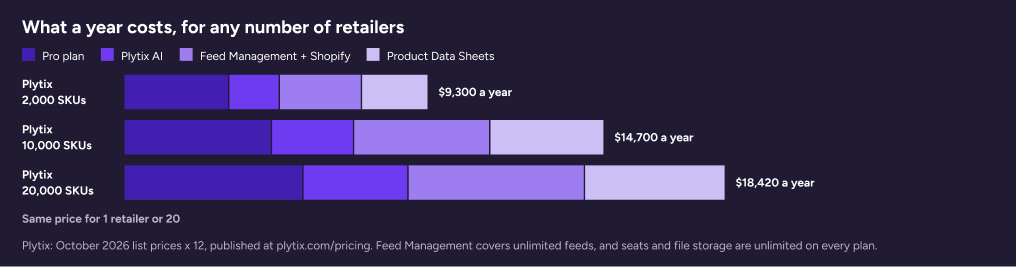
- With Plytix, your price follows your catalog size, not how many retailers you send to. The Feed Management add-on covers as many feeds as you need, and adding people never changes the price.
- Published pricing by SKU count. You see the full cost before you talk to sales.
- Unlimited seats and storage on every plan. Everyone who touches product data can work in Plytix.
- Month to month. No annual contract to renew.
“When looking for a PIM, we demoed a lot of different products. Plytix was by far the most user-friendly and cost-effective option for us.”
“Considering the price of the product, there is no other comparable price/value option on the market now. For organizations looking for a cost-effective PIM solution that combines ease of use, fast deployment, and ongoing innovation, Plytix offers tremendous value and is difficult to outperform within its price segment.”
“A perfect example of an efficient affordable product to modernize your tech stack. It’s clear that the development efforts were user-centric.”
Too complex for the team to run
Syndigo can do a lot, but buyers said its setup was hard for everyday users to change. The more it was customized, the fewer people felt able to touch it.
SYNDIGO: WHAT BUYERS REPORTED
Buyers described setups configured by Syndigo that were hard to change, more features than they used, and teams that drifted back to spreadsheets.
- Buyers described Syndigo as “clunky,” “not user-friendly,” and “too big and complex for the team,” with “too many options that we were not using.”
- One buyer said the setup “took us a while to prop up,” and several brands owned Syndigo but said “it wasn’t used at all,” with product data drifting back to Google Drive and spreadsheets.
- A US online grocer with about 39,000 products said only one contractor could change its Syndigo setup, and the documentation was poor.
“What we found with Syndigo is that it’s not the easiest platform to use when we’re trying to change things on the fly. When they set up our instance, there was a lot of customization that we don’t even dare touch. That is our biggest pain point. It just feels like a lot of effort to add data points or change relationships between the data.”
PLYTIX: HOW IT WORKS
Plytix is built for marketing and ecommerce teams to run without IT. Plytix rates 9.0 for ease of use on G2, compared with 8.0 for Syndigo.
- No agency or system integrator required. Our onboarding team maps your data model and configures your channels.
- Change it yourself. Add a field, a channel, or a user in minutes, with no ticket.
- Unlimited seats. The whole team can work in Plytix, not just the person who set it up.
“We run multiple e-commerce brands and Plytix handles very different catalogs, data models, and brand requirements without making us hack around the tool.”
“We looked for about 2 years before settling on Plytix. We were concerned about programs that were overly complicated and difficult to use. The Plytix team did a great job onboarding us, and we’ve really enjoyed the product. It has been one of the best things we’ve done as far as SAAS partnerships.”
Customer result: Universal Components
A UK distributor of truck and trailer parts with more than 16,000 products, where the marketing team now builds catalogs and manages product data in Plytix instead of the ERP and spreadsheets.
A pipe to retailers, not a source of truth
Syndigo’s retailer connections are real, but buyers said they fed it rather than worked in it. Their product data still lived somewhere else, and reaching customers outside Syndigo’s network meant spreadsheets and file transfers.
SYNDIGO: WHAT BUYERS REPORTED
Buyers described entering the same data separately for each retailer, struggling to get it back out, and still sending images and spec sheets by email or file transfer.
- A US automotive-parts manufacturer spent a large part of every day copy-pasting SKU lists into Syndigo and sending images separately by file transfer, because most of its clients didn’t use Syndigo.
- Buyers said Syndigo “doesn’t work for all marketplaces,” and some found it covered only part of a retailer’s content.
“Syndigo, the way we have it, doesn’t really have this kind of option. This would be great, because oftentimes someone will be panicking. They’re like, I need the specs or the dimensions on this one SKU, and I would share this link with them in the first place, and they probably wouldn’t even need to reach out about it.”
“A couple years ago, we worked with Syndigo, and we manually uploaded our packaging, and we had a limit on how many items we could upload. So it was kind of a one-time thing, and all those retailers are still pulling those assets.”
PLYTIX: HOW IT WORKS
With Plytix, your product data lives in one record your team owns, and you share it from there with every retailer, distributor, and marketplace.
- Feeds for every retailer. The Feed Management add-on builds feeds from the templates your retailers already use.
- Brand Portals for your customers. Distributors and sales teams download images and data themselves with the Brand Portals add-on.
- Spec sheets from the same record. Build them with the Product Data Sheets add-on.
- Your data, always yours. Export anything, anytime, or connect through the API on every plan.
“It helps us have an internal portal of our products, with data and images that many users need and do not have direct access to. Additionally, it allows sharing information with other external platforms without needing to review it again.”
“Using channels was a complete gamechanger for populating masterdata files for our retailers. It saved us both time and money plus decreased our time to market.”
“We have everything live in one place, and getting our product info to the right people is remarkably easy and simple. Additionally, the e-catalogs allow us to have our sales reps/whoever else pull whatever info or images that they need on their own.”
Customer result: Alltrade Tools
A maker of tools for cars, homes, and garages with about 5,000 products and 50 people working in Plytix.
Plytix and Syndigo, side by side
What teams get with Plytix
“With Plytix, we're able to share products with retail partners 3x faster. How? We swapped our spreadsheets for live feeds.”
Austin, Product Data Officer, Twisted X. Customer story.
“We saved 10 hours a week and grew our client portfolio when we switched to Brand Portals instead of printed product catalogs.”
Sabina Belser, Head of Marketing, Musco Food. Customer story.
Switching from Syndigo is simpler than you think
Your product data is already centralized, so you start from structured data, not spreadsheets. Our onboarding team handles the heavy lifting.