The Plytix Mission
Why we exist, what we're building,
and the six commitments we hold ourselves to.
Why we exist
Our reason to exist is simple: help the right products get in front of the right people at the right time.
That's the whole ambition, and every part of it matters. The right products, meaning the ones that fit what someone needs, not the ones with the biggest ad budget. The right people, meaning the buyer who will be happy with the purchase, not just anyone who can be persuaded to click. And the right time, which for us has a precise meaning: the moment when someone is actively researching or searching for a product. When they're in-market. Not before, when it's noise, and not after, when it's too late.
We believe product information is the key to all of it.
We believe product information is the key to all of it.
Product information as the great equalizer
Think about what happens when a consumer goes looking for something today.
They search, and they get pages of results. Some products are described well: complete specifications, clear images, honest descriptions, the details that matter for that particular category and that particular channel.
Unfortunately, most are not. Most are thin, inconsistent, copied from a supplier sheet, or optimized for nothing in particular.
The consumer ends up sorting through endless pages of noise and, too often, buying something sub-par because the better option was never properly presented
That's a failure of product information, not a failure of the products.
When every product sold is fully enriched and optimized for the channel it's sold on, something changes. Consumers get exposed to the products that are most relevant to them, and they have everything they need to make an informed decision.
The small brand with the better product gets a fair shot against the big brand with the bigger budget, because the buyer can actually see the difference. Good product content is the antidote to bad buying, and it's the great equalizer in commerce.
Our mission
That's why our mission is to make PIM (Product Information Management) a default technology in the tech stack of every business, big or small, selling physical products.
Not a luxury for enterprises with dedicated data teams. Not a project that takes eighteen months and a consultant. A default. Something every business selling products across multiple channels simply has, the way they have an accounting system, because running without one has stopped making sense.
Not a luxury for enterprises with dedicated data teams. Not a project that takes eighteen months and a consultant. A default. Something every business selling products across multiple channels simply has, the way they have an accounting system, because running without one has stopped making sense.
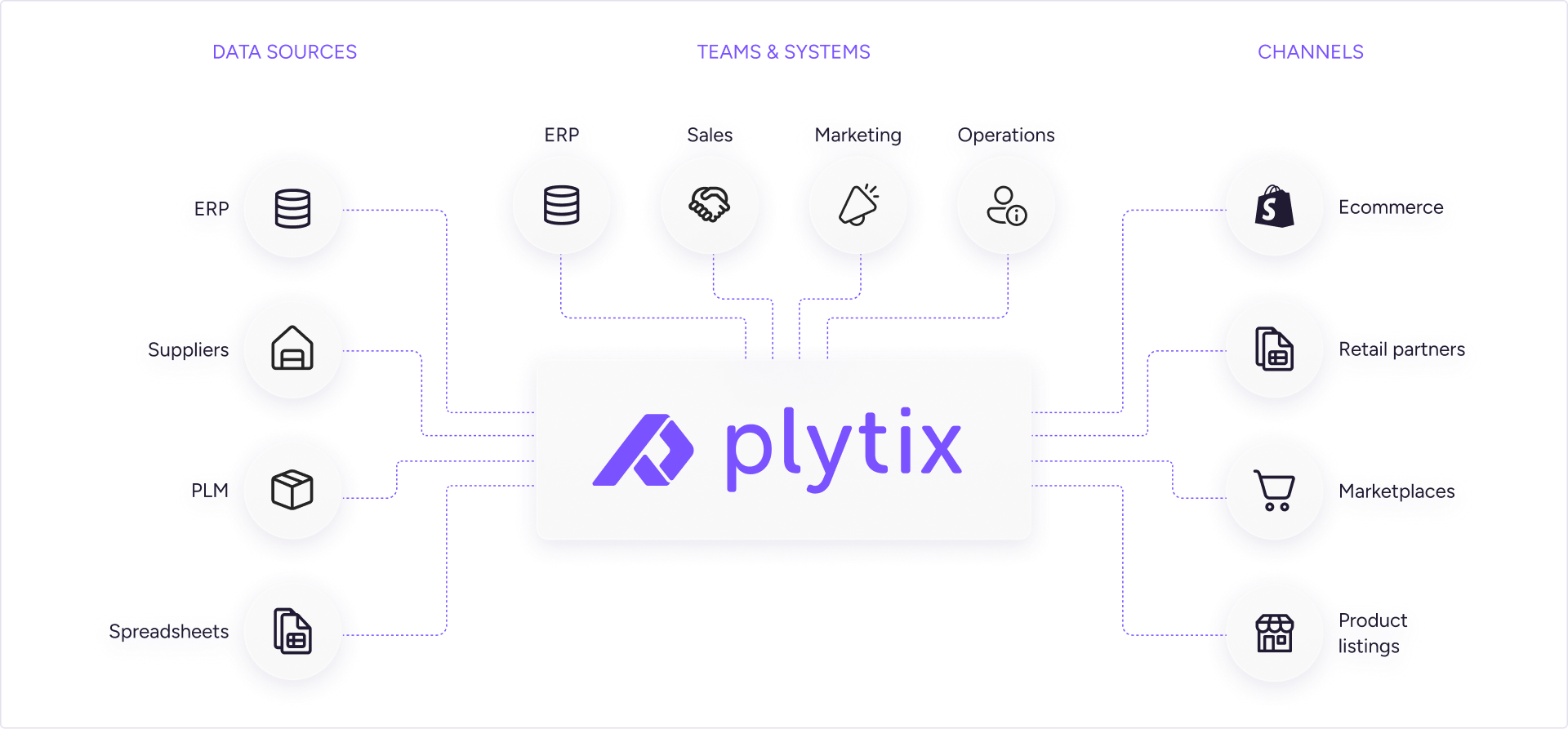
We believe PIM is the most instrumental system of record for accurate and optimized product content across multiple sales channels. It's where product information becomes trustworthy, and from where it flows out to every place a product is sold
How we get there
To achieve this mission, we have two obligations. First, we have to build the most reliable system of record for product information. Second, we have to make it available to companies of all sizes.
Neither is optional. A reliable system that only large companies can afford or operate doesn't make PIM a default commodity.
Neither is optional. A reliable system that only large companies can afford or operate doesn't make PIM a default commodity.
A user-friendly and affordable system that can't be trusted doesn't either. So both obligations get equal weight, and each breaks down into three commitments. Six in total. These are the things we live and breathe for, and they are the criteria we hold every strategic decision against.
PART 1
Building the most reliable system of record
1: We’re committed to building a system of record you can trust
Product information shouldn't be trapped in a single tool, a single team, or a single workflow. We acknowledge that's not how most organizations work. Product data passes through multiple teams, and every team has their own software, their own routines, and their own systems of record.
Our job is not to replace all of that with Plytix. Our job is to make Plytix the reliable system of record that connects all of it and keeps your product information accurate and up-to-date.
In practice, that means two things. First, it has to be easy to get product information into Plytix, whether it arrives through a manual import, a scheduled file, an API, a webhook, or an integration.
Second, once it's there, you should be able to rely on Plytix to keep every connected system updated when something changes. Plytix should fit the workflow a company already has, not force a new one.
A system of record that drifts out of sync isn't a system of record. It's another copy. So we're committed to building the most reliable (and still agile) system of record we can: one that speaks clearly with other systems, keeps information synchronized, and gives teams confidence that the product data in their own tool is correct because Plytix made sure it is.
A system of record that drifts out of sync isn't a system of record. It's another copy. So we're committed to building the most reliable (and still agile) system of record we can: one that speaks clearly with other systems, keeps information synchronized, and gives teams confidence that the product data in their own tool is correct because Plytix made sure it is.
Connecting the stack is not an integration roadmap for us. It's the job.
2: We’re committed to making Plytix always relevant
Things change, and sometimes workflows, strategies, and technologies are rendered obsolete. We don’t get hung up on sunk-cost fallacies. We embrace change and adapt.
At the time of writing, this means that we’re devoted to making Plytix the most agent-friendly PIM on the market. Or set in different words, at the time of writing our main priority is to make Plytix an MCP-first platform.
AI assistants and agentic workflows are quickly becoming part of everyday work, and they fundamentally change what product data is worth. Its value now depends on how reliably it can be accessed, understood, and acted on by something other than a person clicking through an interface. Plytix should not require customers to do everything inside our UI. It should be the dependable product-information foundation that works with whatever tools and workflows they choose.
That's why we're committed to being an agent-friendly system of record. Our product data has to be structured, accurate, and accessible through robust, well-documented APIs and MCP, so customers can connect Plytix to the AI tools, assistants, and workflows they already use.
This matters because agents are only as useful as the information they work with. When product data is scattered across spreadsheets, folders, and disconnected systems, an agent can't reliably act on it. It will guess, and it will be wrong. When that data lives in Plytix, teams have a trusted, structured source their tools can draw from with confidence.
Our role is not to become the orchestration layer for every workflow. It is to make Plytix the product-information system those workflows can rely on: accurate, connected, and ready to work wherever our customers work.
3: We’re committed to building the best AI for product content
We believe AI should make product content better, not just faster.
We acknowledge that creating, enriching, and adapting product content across channels takes real time and real expertise. Generic AI can produce words on demand, but it doesn't know your products, your standards, or what each marketplace actually rewards. Faster output of the wrong content is not progress.
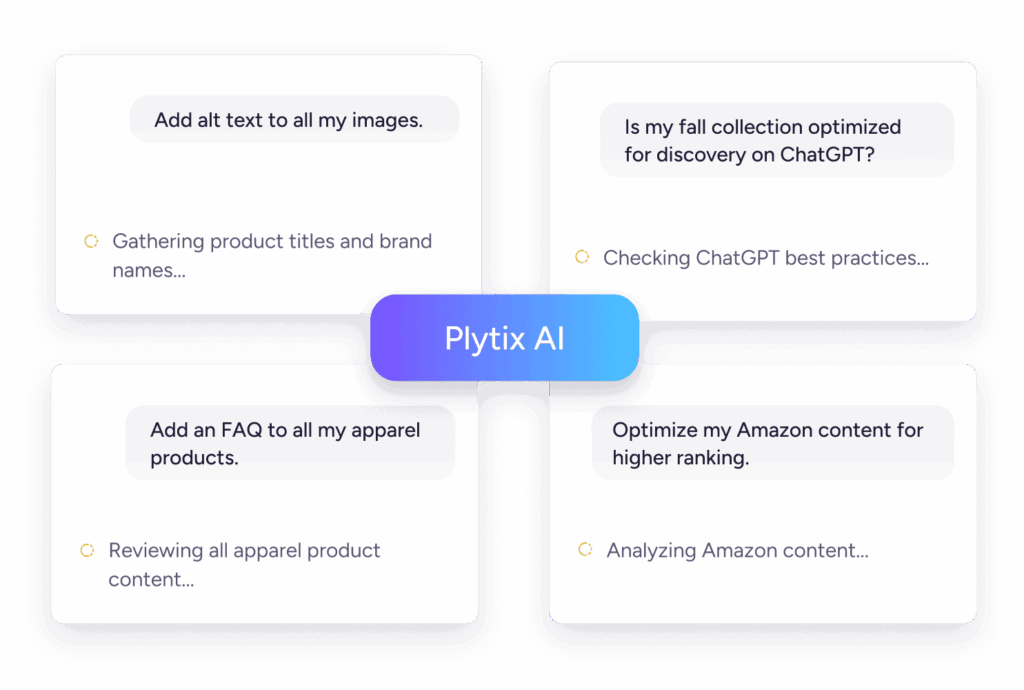
That's why we're building Belinda, Plytix's AI content specialist. She is built around the product information already in Plytix and designed to do the specific jobs product teams need done, from improving existing content to adapting it for a particular channel.
What makes Belinda different is what she learns from. We employ a dedicated ecommerce unit whose only job is to test product content adaptations across verticals, marketplaces, and platforms to find the small edges that make products rank higher.
Those insights train Belinda every day. She also learns from aggregated data across the thousands of commerce businesses running their multichannel strategy through Plytix, so she knows what actually works on each sales channel, not what a generic model guesses.
We're committed to this because content quality is a competitive advantage, and teams shouldn't have to choose between scale and accuracy, or between speed and brand voice. This commitment is also where the mission becomes most tangible: fully enriched, channel-optimized content for every product is exactly what puts the right products in front of the right people.
We're not building another generic AI model. Our ambition is for Belinda to be the best content agent in the world for product content, earned the slow way: grounded in your data, tested daily against real marketplaces, and improved around the work product teams actually do.
PART 2
Making it available to companies of all sizes
4: We’re committed to making Plytix intuitive and user-friendly
We acknowledge that managing product information happens in almost every team in your organization in some shape or form.
For some, it means logging into Plytix once a month. For others, it is the main place of work. Whether you rely on Plytix daily or once a month, it should be insanely intuitive for you to get whatever you need done.
We've made a standing decision to always remove friction for our users rather than for ourselves, even when it's slower and more expensive for us. Every bit of friction we leave in the product is a reason for someone to keep a spreadsheet on the side, and once that spreadsheet exists, there’s fragmented and inconsistent product information.
Our product managers and product designers are mandated to devote a fixed portion of their time to watching anonymized sessions of how users actually interact with the interface. Not interviews, not surveys. Real sessions, showing where the cursor hesitates and where a task that should take three steps quietly takes eleven. Friction points don't announce themselves. The only way to find them is to go looking, regularly.
This is one of the most important pillars of democratizing our platform and making sure that our powerful technology is available and accessible to everyone.


5: We’re committed to democratizing our technology
We believe every business selling products deserves access to PIM. Not just the ones with dedicated data teams and enterprise budgets. So we price Plytix to stay within reach for companies of every size, not for what the market will bear.
Most PIM vendors price by company size or charge extra for features that should be standard, which quietly prices smaller teams out. We built Plytix to be the exception.
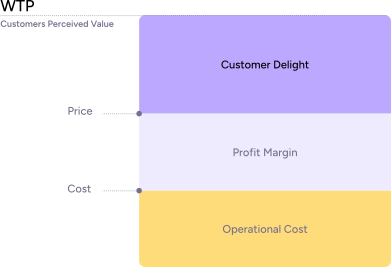
When we say our mission decides our pricing, not our profit margins, we mean it. We're often accused of leaving money on the table. But then we remind ourselves what we're actually solving for: customer delight first, shareholder value second.
We define customer delight as simply as; the gap between what a customer pays and the value they get from it. The bigger that gap, the more delighted they are. See the figure below.
6: We’re committed to our customers happiness
We know that most software companies tier their support: the more you pay, the more attention you get, and smaller customers are often neglected or routed to a help center.
That strategy wouldn’t work for us because it would be counterproductive to our mission. If our mission is to make PIM a default commodity in companies' tech stack, then it is also our duty to invest in our customers and be there for them, proactively as well as reactively.
In order to stay committed to customer happiness, we have deliberately resisted the temptation to implement productivity targets when it comes to customer support. We firmly believe that a customer's support needs, and nothing else, must be the sole factor determining the level of attention they receive from our team.