
What is digital asset management (DAM)? A Guide for Ecommerce Brands
What is digital asset management software and why is it important?
At its core, digital asset management software is a central database used to store, organize, and distribute digital files. Many organizations use a DAM purely for brand management, giving their internal teams a secure place to access corporate logos, creative files, and marketing collateral.
But when you sell products online, the role of a DAM changes completely. Digital assets are no longer just internal reference files. They are the product photos, packshots, lifestyle images, spec sheets, and videos that actually drive purchasing decisions.
For an ecommerce brand, the challenge goes far beyond basic file storage. You have to manage media across an entire catalog and push it to multiple sales channels, each with its own strict image rules. Above all, every photo, video, or packaging asset has to line up with the exact right SKU without someone having to check it manually.
This requires a very specific approach to asset management. Selling online means you need a system that connects your media directly to your product data, a requirement that makes integrating your DAM with a Product Information Management (PIM) system a massive priority.
What are the benefits of digital asset management for ecommerce?
The primary benefits of digital asset management for ecommerce are launching products faster, maximizing the return on your creative investments, and preventing costly returns. For your business, that means:
Launch products faster
Getting a new product live requires specific imagery for every channel. With a DAM, your assets are formatted and ready for distribution automatically, cutting your time to market from days to hours.
Maximize your creative ROI
Every asset your team creates has a production cost behind it. A DAM makes sure you actually use what you have paid for and can reuse it across channels without paying to recreate things that already exist.
Expand to new channels easily
Every sales channel has its own image specs. Amazon wants 1000×1000 px on a white background, while Instagram wants a square crop. A DAM automates channel-specific formatting so you can expand without doubling your creative workload.
Reduce returns and protect your brand
A wrong product image or last year’s packaging going live is not just embarrassing. It costs real money in returns and lost buyer trust. A DAM ensures the right assets reach the right places, and nothing outdated slips through.
What does DAM do for your team?
No more asking "where is that file?"
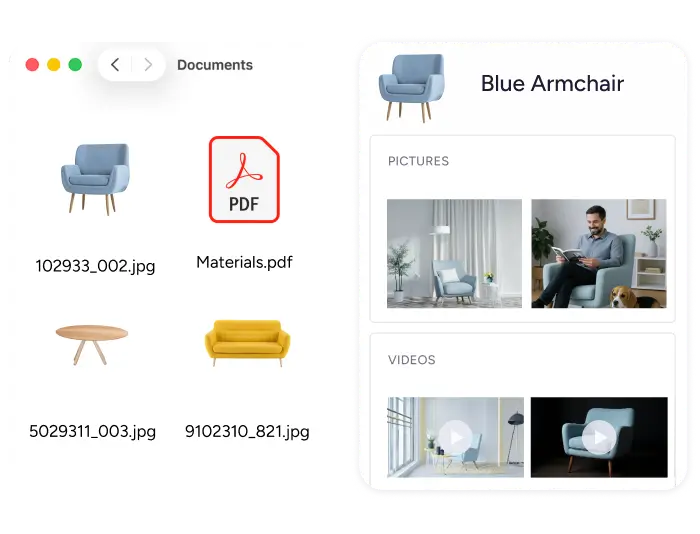
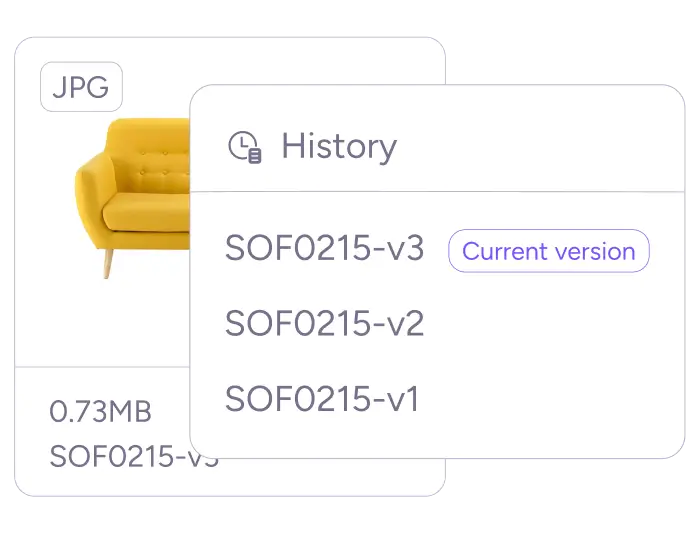
A single source of truth
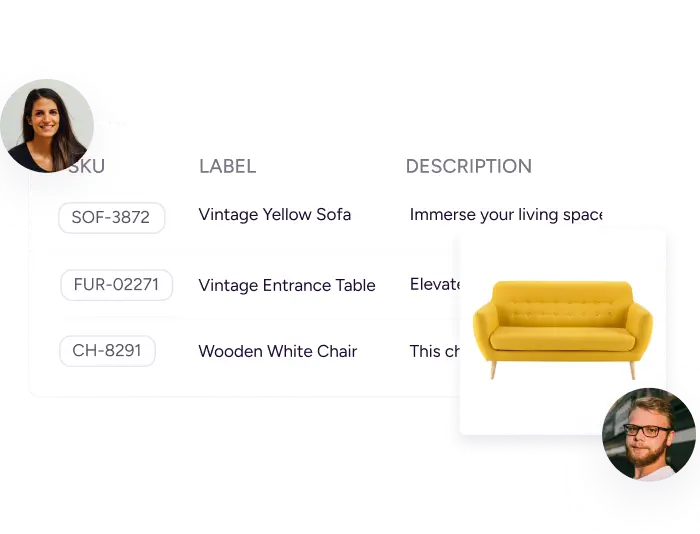
Better team collaboration
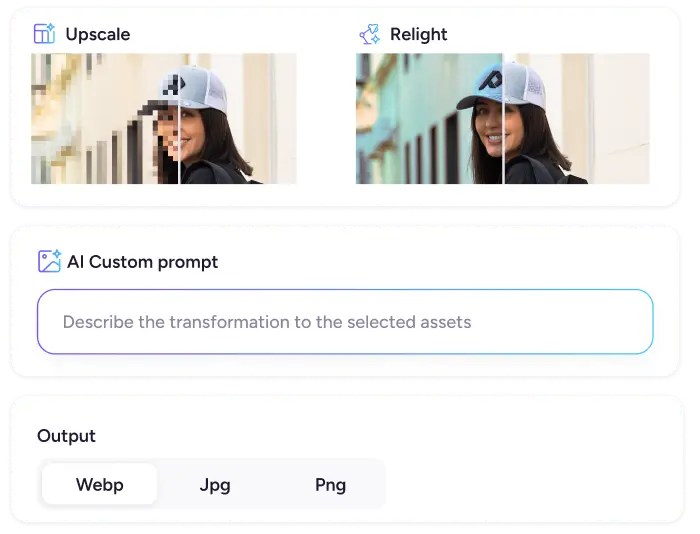
Transform images in seconds
What digital assets do you need to sell online?
Product photos
Videos
PDFs and documents
3D models and AR files
Icons and badges
Packaging and labels
Digital swatches and textures
User-generated content (UGC)
Marketplace and A+ content
How does DAM software work for product catalogs?
Centralize
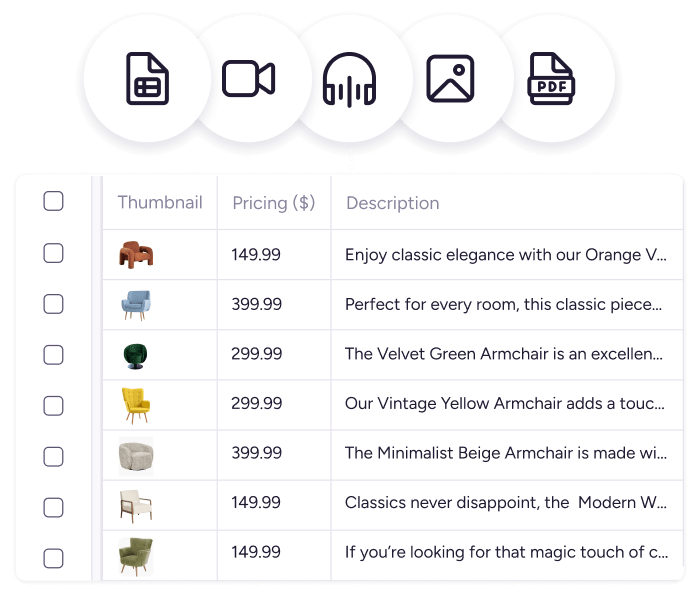
Optimize

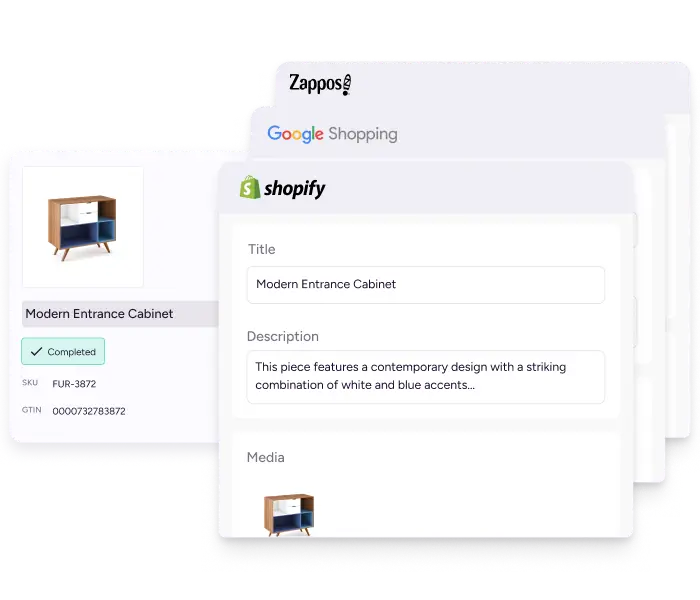
Distribute
Where does DAM fit in your tech stack?
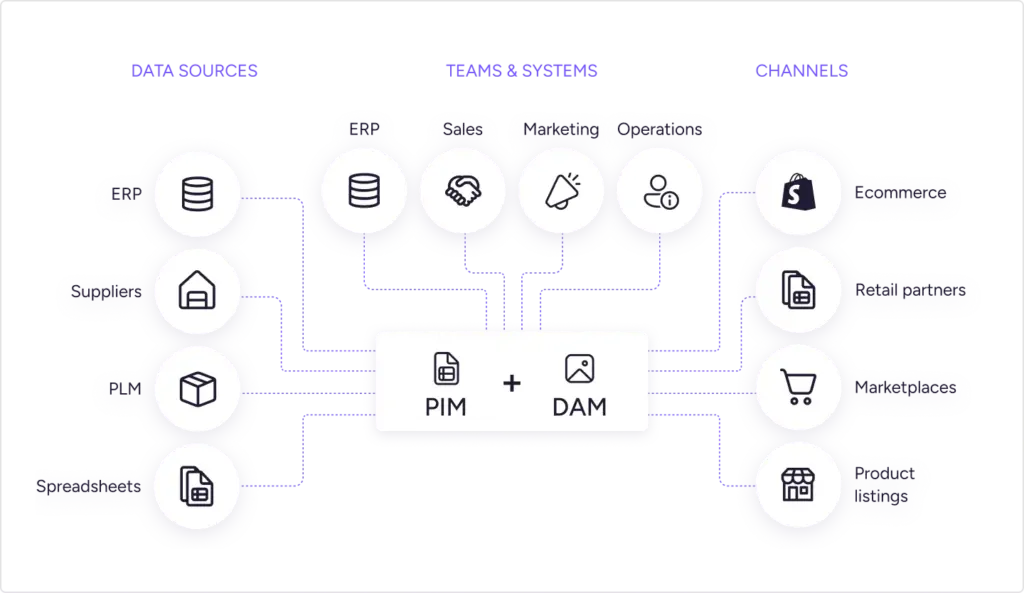
Upstream: where media comes in
- ERP systems supply core product records, base SKUs, and inventory data.
- Photographers and agencies upload raw product photography, campaign videos, and 3D renders.
- Suppliers and factory partners submit technical spec sheets, compliance PDFs, and box artwork.
- DAM software collects these incoming files, sorts them cleanly into categories, and attaches them directly to the right SKUs.
Downstream: where media goes out
- Ecommerce stores receive channel-ready product images cropped and resized automatically.
- Marketplaces receive hosted image URLs formatted to strict white-background guidelines.
- Wholesale buyers access approved brand assets through self-service portals.
- Sales teams pull high-resolution photos and spec sheets directly into PDF data sheets.
Which teams use a DAM system?
Marketing teams
Ecommerce and catalog managers
Creative and design teams
Sales teams
Product teams
External partners and agencies
What types of companies use ecommerce DAM software?
Manufacturers
Brands
Distributors
Multichannel Retailers
What to look for in a digital asset management platform
Centralize
Optimize
Distribute
See how Plytix handles all of this in one platform.
Why choose a PIM DAM integration?
Connecting PIM and DAM creates one of the most effective digital asset management solutions for high-volume multichannel brands.
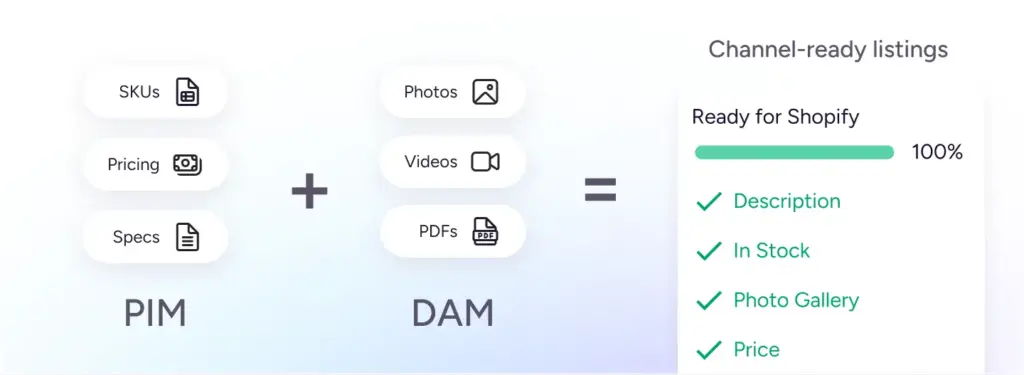
A PIM DAM integration combines structured product data (SKUs, pricing, specifications) with digital media assets (photos, videos, PDFs) in one central platform.
A native PIM and DAM system eliminates manual file-to-SKU matching, prevents data drift across sales channels, and cuts product launch times from weeks to minutes.
Why standalone DAMs fail without PIM
Key business benefits of a native PIM DAM platform
Eliminates manual data matching
Asset assignments travel automatically with the product record, removing 30 to 150 hours per 100 SKUs spent manually pairing images to data.
Ensures single-source brand consistency
Updating a master image or spec sheet in one place automatically cascades approved assets across every connected channel and Brand Portal.
Accelerates time-to-market
Cross-functional teams enrich product copy and visual assets in parallel rather than waiting on sequential handoffs or database syncs.
Want a deeper dive into how PIM and DAM work together?
Cloud digital asset management vs. standalone DAM vs. PIM
The quick breakdown
- Cloud storage (Google Drive, Dropbox)
Fine for backing up files, but useless for online selling because your images aren’t connected to your SKUs. - Standalone DAM (Bynder, Canto)
Great for marketing teams managing campaign content, but it sits separate from your product data, meaning you still have to manually match images to product listings. - PIM-integrated DAM (Plytix)
Built specifically for product catalogs. It ties your images straight to your SKUs so your store listings, marketplace feeds, and spec sheets update automatically.
What is the future of digital asset management in ecommerce?
AI handles visual optimization automatically
Visual search relies heavily on embedded metadata
3D models and synthetic media need strict version control
Compliance documentation is becoming visual
Product DAM sits right at the middle of all this. Whether you are feeding AI search engines, managing 3D files, or prepping for new compliance rules, the brands that adapt fastest are the ones with clean, SKU-linked media assets today.
FAQs
An ecommerce DAM (digital asset management) software is a centralized software system that stores, organizes, and distributes product media (such as photography, videos, 3D assets, and spec sheets) by linking them directly to product SKUs and sales channel feeds.
PIM (Product Information Management) manages structured product data like SKUs, specifications, pricing, and written descriptions. DAM handles visual media like photos, videos, and PDFs. PIM tells the product story in words and data, while DAM shows it in visuals.
Most PIM systems can store basic image files for simple catalog listings. However, a dedicated DAM provides advanced features like high-res master file storage, version control, dynamic image resizing, automated CDN hosting, and brand portals.
A standalone DAM can hold basic metadata tags and custom fields, but it cannot handle complex product relationship structures, localized copy, variant hierarchies, pricing, or channel feed syndication rules.
For data-heavy catalogs with many technical specs or variants, implement PIM first to establish a clean data foundation. For visual-first brands struggling with asset organization across marketing channels, implement DAM first. Multichannel ecommerce brands usually benefit most from adopting both together.
A native PIM DAM system is a single software platform where product information and digital media share the same database layer. This eliminates the need to build, maintain, or troubleshoot an integration between two separate software platforms.