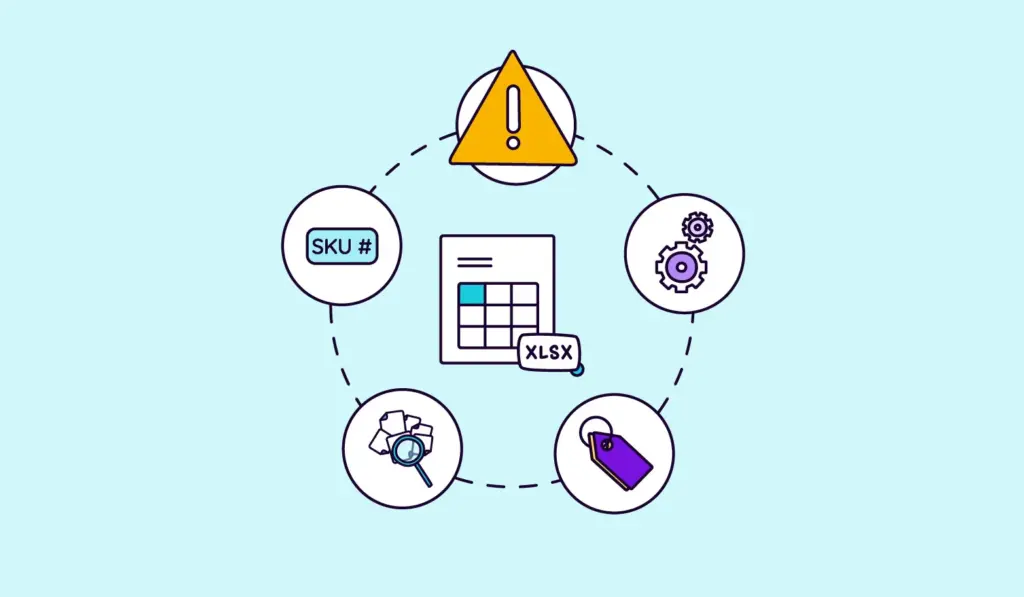
What is PIM?
PIM software (short for product information management) is a centralized platform where you store, enrich, and distribute all your product data. Think titles, descriptions, specs, images, pricing, and every other detail, kept in one place and pushed out to every channel you sell on.
Instead of chasing product information across spreadsheets, inboxes, and a bunch of tools, your whole team works from a single source of truth. That means less manual busywork, fewer errors, and faster launches.
A good PIM helps you:
- Centralize product data and digital assets in one place
- Enrich listings and spot what’s missing before it goes live
- Optimize content for each channel, from your webstore to marketplaces
- Distribute accurate, up-to-date data everywhere you sell, automatically
Why PIM matters more in 2026
Good product data has always mattered. In 2026, it's the difference between getting found and getting passed over. Plytix dug into the numbers for its 2026 Commerce Napkin reports, surveying over 800 commerce companies across five verticals.
Here’s what we found:
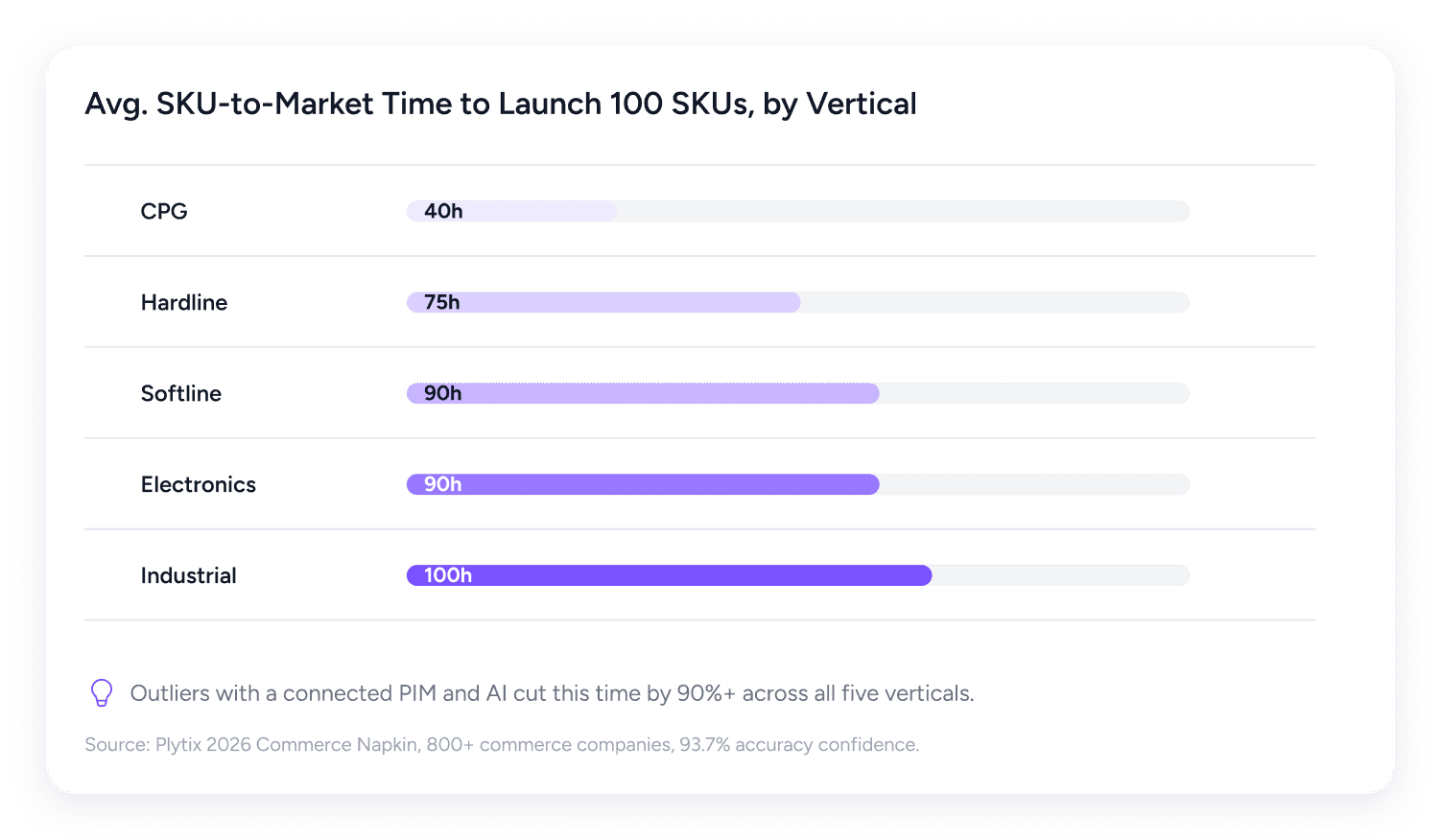
- Slow launches: mid-market brands spend 40 to 100 hours to launch just 100 SKUs.
- Falling discoverability: products are getting harder to find across most verticals, with Electronics brands seeing drops as steep as 15% year over year.
- Who is actually winning: the brands beating that trend all ran a connected PIM as their single source of truth, which lined up with cutting SKU-to-market time by more than 90%.
And that gap is only going to widen this year. That’s because two things changed in 2026, and both center around product data: AI started doing the buying, and the EU started requiring traceable product data.
1. Agentic commerce arrived
Google launched the Universal Commerce Protocol in January 2026 with Shopify, Walmart, and Target. AI agents can now search, compare, and check out for shoppers inside AI Mode and the Gemini app. And shoppers are already there: half of US shoppers who use AI tools have made a purchase after researching with AI, and 55% use AI for product research at least once a week.
Agents don't browse. They read structured product data and pick what fits: accurate specs, complete images, correct pricing, and detailed descriptions. If any of that is missing, your product gets passed over.
2. The EU made structured data a requirement
If you sell in the EU, product data is about to become a compliance job. The EU's central Digital Product Passport registry is due to be in place from July 2026, and batteries are first in line for mandatory passports in February 2027. Textiles, electronics, and furniture are next.
Your category may not have a deadline yet, but getting a head start on setting up your data structures will help keep you from drowning in product data at the last minute.
What this means for your PIM shortlist
Both shifts point to the same job: keep product data complete, accurate, and structured, then send it to every channel. That's what a PIM does. But not every PIM is equally ready for what 2026 asks of it, so put these two questions to every provider you talk to:
Is the AI included or a paid add-on? Almost every top PIM shipped agentic AI features this year, and some opened up so AI tools can pull product data directly. Ask what's in the base plan and what costs extra. Plytix, for example, includes AI for free.
How does it support Digital Product Passport data? Ask whether you can store, structure, and publish the traceability fields your category will need, and whether the provider has a plan for the delegated acts still to come.
Get this right, and you don't need the biggest budget to compete. When AI judges on data and value, the brand with the best product information wins.
See how Plytix helps you get your products ready for whatever's next.
How we ranked the best PIM software
Most "best PIM" lists are feature checklists in disguise. We skipped that. A mile-long spec sheet means nothing if the tool takes six months to set up or costs more than your entire marketing budget. So we ranked on what actually counts. Every PIM below went through the same seven criteria:
| Criteria | What we looked at |
|---|---|
| Who it’s built for | Small teams, mid-market, or enterprise |
| Ease of use and setup | How fast you go live, and whether you’ll need IT or consultants to get there |
| Support | How easy it is to get help, and whether there’s a real person on the other end |
| Core capabilities | PIM, plus DAM, feed management, distribution, and AI where it actually counts |
| Integrations | How well it connects with your ecommerce platform, ERP, and sales channels |
| Pricing and transparency | What it really costs, and whether that number is even public |
| Real reviews | Verified G2 scores |
Every score and price about these top PIM solutions comes from public sources (like G2 and Capterra) and each vendor's own materials. And when a competitor does something better than Plytix, we'll let you know.
PIM software comparison at a glance
Here’s how the 13 platforms compare on what buyers ask about first: who each one is built for, what it costs, how users rate it, and whether AI comes included or costs extra.
| Platform | Best for | Pricing from | G2 score | Free plan | AI in base plan |
|---|---|---|---|---|---|
| Plytix | Growing and mid-market ecommerce teams | €499/month | 4.7 | Yes | Yes, free in every account |
| Akeneo | Large enterprises with complex catalogs | €35,000/year | 4.4 | Open source only | No, premium add-on |
| Salsify | Brands selling into major retail chains | Custom quote | 4.4 | No | No, paid add-on tiers |
| Sales Layer | European marketplace syndication | Custom quote | 4.6 | No | No, enterprise tier |
| Syndigo | GDSN compliance and broad retailer reach | Custom quote | 4.4 | No | No, enterprise governance tier |
| Pimberly | Supplier-heavy enterprise catalogs | $36,000/year | 4.4 | No | No |
| Ergonode | Internal catalog workflows | €5,990/year | 4.6 | Yes | No |
| Kontainer | DAM-first teams with heavy video | €590/month | 4.5 | No | No |
| Quable | Mid-market catalog structure | $1,745/month | 4.4 | No | Yes |
| Bluestone PIM | Composable commerce stacks | $3,000/month | 4.8 | No | Not listed |
| Catsy | B2B manufacturers and print catalogs | Custom quote | 4.8 | No | Not listed |
| Inriver | Large multinationals running SAP | Custom quote | 4.2 | No | No, higher tiers only |
| Pimcore | Developer-led, self-hosted builds | €8,400/year | 4.5 | Open source only | Needs developer setup |
13 best PIM systems ranked in 2026
Plytix takes the top spot for growing commerce teams, but the right PIM really does depend on your needs. Here's an honest PIM software comparison of the 13 strongest options, judged on the criteria above, and exactly who each one is for.
1. Plytix
The enterprise-grade PIM, DAM, and feed management tool for growing commerce teams, without the enterprise price tag or setup.
Best for: Growing and mid-market brands, especially DTC and Shopify sellers. Ecommerce and product managers can run product data, digital assets, and sales channels without waiting on IT for every update.
Strengths:
- PIM, DAM, and feed management in one platform, so there are no separate tools or contracts to manage
- Free AI in every plan, including translation, image editing, and agentic commerce templates
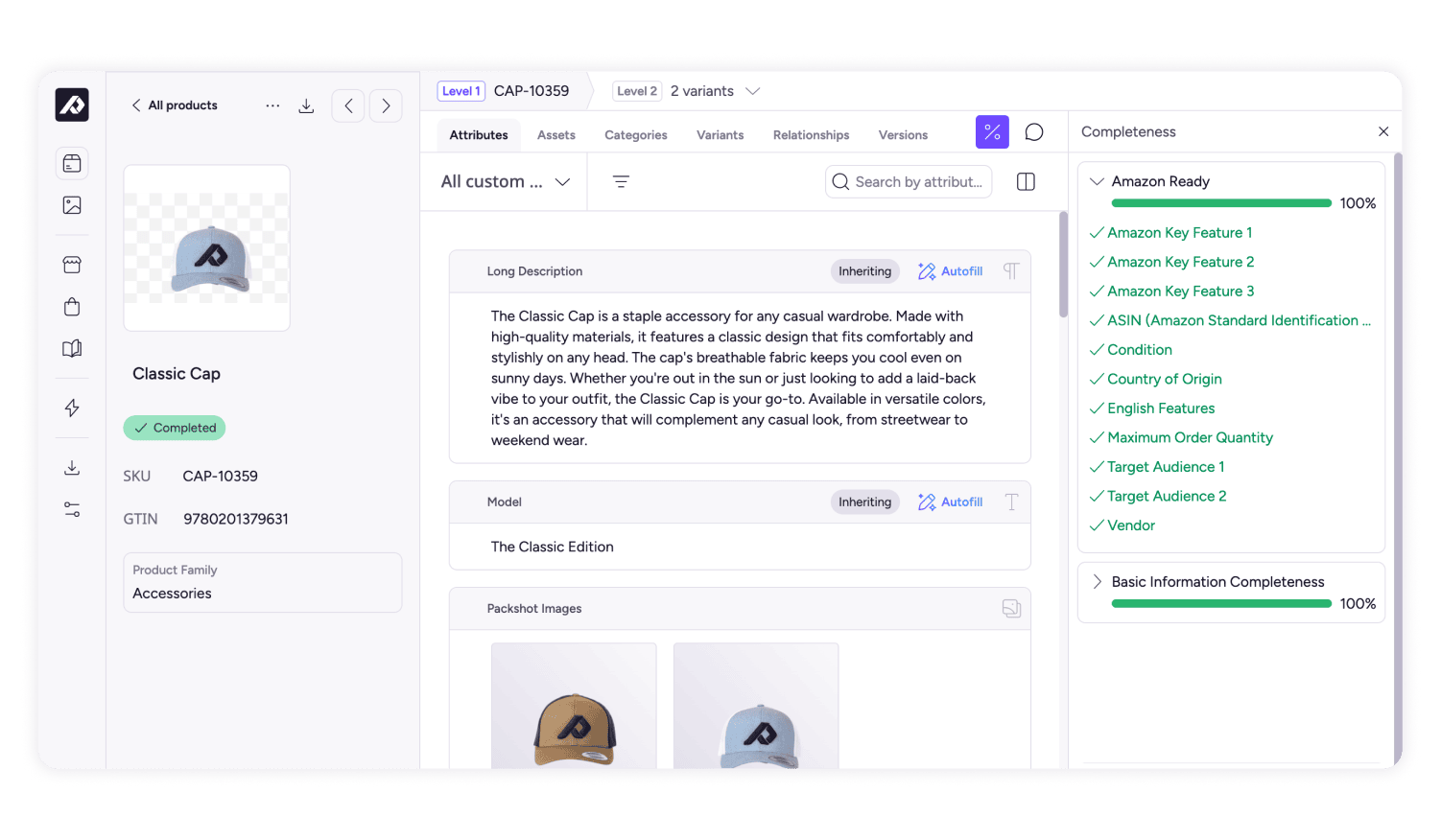
- Native Shopify workflows out of the box: bulk editing, completeness scoring, and channel sync
- Unlimited users and a dedicated account manager on every paid plan
Keep in mind:
- If you need heavy customization or complex global governance, a traditional enterprise PIM is the better fit
- Built for teams who manage product data themselves, not for setups where IT owns day-to-day changes.
Pricing: Free plan available; paid plans from €499/month.
G2 score: 4.7 (400+ reviews), ranked #1 easiest PIM to use and #4 on G2's Best Commerce Software list.
“Plytix is genuinely easy to use compared to other PIM systems, especially for day-to-day product data management.”
— Maz M., Ecommerce Product Manager, G2 Review
2. Akeneo
The enterprise PXM market leader, built for complex, multichannel product experience at scale.
Best for: Large enterprises with highly complex catalogs that need deep customization, multi-market governance, and a dedicated IT or implementation team.
Strengths:
- Deep governance and workflow customization across multiple markets
- Powerful data modeling and validation for large, complex catalogs
- Strong marketplace and channel syndication connectors
- AI enrichment, including content generation and automated attribute extraction
Keep in mind:
- Implementation is IT-heavy and usually consultant-driven, with no self-serve path
- Pricing takes a sales conversation, no public tiers
- AI is a paid add-on, not part of the base plan
Pricing: Free (open-source); paid plans from €35,000/year.
G2 score: 4.4 (245 reviews).
3. Salsify
The enterprise PXM built around direct retailer integrations and digital shelf performance.
Best for: Large brands that sell directly into major retail chains that need a PIM with direct API connections into each retailer's backend.
Strengths:
- Direct integrations into major retail chain systems
- Tools to meet each retailer’s content requirements without manual reformatting
- AI content automation for teams submitting to retailers in high volume
Keep in mind:
- Heavy enterprise implementation, not built for teams that need to move fast
- Custom pricing only, no public tiers
- AI sits in paid add-on tiers, not the base plan
Pricing: Custom quote.
G2 score: 4.4 (120 reviews).
4. Sales Layer
A PIM strong in European marketplace syndication and multilingual catalogs.
Best for: Manufacturers, retailers, and distributors selling across EU marketplaces.
Strengths:
- Pre-built connections into major European marketplaces
- Multilingual content management across European languages
- AWS-hosted infrastructure that handles growth
Keep in mind:
- Setup gets complicated for teams without large, structured catalogs
- Pricing scales with product volume, so total cost is hard to predict as you grow
- AI is enterprise-tier, not part of standard plans
Pricing: Custom quote.
G2 score: 4.6 (316 reviews).
5. Syndigo
An enterprise PIM with a pre-built network of retailers ready to receive product data.
Best for: Large global brands with GDSN requirements that need to reach thousands of retailers.
Strengths:
- Pre-built connections to more retailers than any other platform on this list
- Tools to improve how products look and convert on retailer sites
- Built for large teams that need audit trails and oversight
Keep in mind:
- Long, consultant-dependent implementations
- No public pricing
- Steep learning curve that calls for technical and compliance expertise
Pricing: Custom quote.
G2 score: 4.4 (560 reviews).
6. Pimberly
An enterprise PIM and DAM platform built around automated supplier onboarding and data validation.
Best for: Enterprises with large, supplier-heavy catalogs that need automated data governance and asset management in one place.
Strengths:
- PIM and DAM in one platform, no separate tools needed
- Automated supplier onboarding and built-in data validation
Keep in mind:
- Starts around $36,000/year, with no self-serve pricing
- Onboarding is specialist-driven and takes time
- No native Shopify workflows or built-in AI content tools
Pricing: From $36,000/year.
G2 score: 4.4 (220 reviews).
7. Ergonode
A PIM built around keeping product data organized and internal workflows running smoothly.
Best for: Teams with messy internal catalogs that need workflow and organization more than channel growth.
Strengths:
- Free tier and an intuitive interface
- Strong workflow automation
- Open-SaaS architecture that grows with you
Keep in mind:
- Data cleanup can delay go-live considerably
- No built-in AI translation, image editing, or channel-specific completeness scoring
- Setup can stall smaller teams without technical help
Pricing: Free tier; paid from €5,990/year.
G2 score: 4.6 (36 reviews).
8. Kontainer
A DAM-first platform with PIM, strong on rich media and video.
Best for: Brands that lead with digital assets, especially video, and want DAM and PIM in one place.
Strengths:
- Built-in video DAM with conversion, subtitles, and CDN streaming
- One contract for DAM and PIM
- Fits the Microsoft ecosystem
Keep in mind:
- Regional focus, with migration fees flagged by the vendor
- No native AI content tools.
Pricing: Paid PIM plans from €590/month.
G2 score: 4.5 (342 reviews).
9. Quable
A SaaS PIM built for mid-market teams that need structured catalog management and cross-team workflow controls.
Best for: Mid-market brands and manufacturers with disorganized catalogs that need structure across internal teams more than channel growth.
Strengths:
- Clean, customizable interface accessible to all teams without technical knowledge
- Strong workflow and collaboration tools for managing how product data moves across teams
- Solid catalog structure and data modeling for organized, complex product ranges
Keep in mind:
- No free plan available, starting at $1,745/month
- API flexibility is limited, which can slow down channel connections and integrations
- No documented native Shopify workflows or built-in AI content tools
Pricing: From $1,745/month.
G2 score: 4.4 (154 reviews)
10. Bluestone PIM
A developer-first PIM built for enterprises adopting composable commerce architectures.
Best for: Technical teams with custom composable stacks that need a PIM they can connect via API.
Strengths:
- The first MACH-certified PIM, purpose-built for composable commerce from the ground up
- 500+ APIs for connecting across any custom tech stack
- Real-time product data delivery across channels and endpoints
Keep in mind:
- Starts at $3,000/month with pricing that scales across users, SKUs, languages, and API calls
- Requires technical resources to implement and maintain, no self-serve setup path
- Not designed for ecommerce teams managing day-to-day product content without IT
Pricing: From $3,000/month.
G2 score: 4.8 (5 reviews)
11. Catsy
A combined PIM and DAM built for manufacturers and B2B brands with complex technical specs and print catalog needs.
Best for: Manufacturers, B2B brands, and wholesale distributors with spec-driven catalogs who need to publish accurate technical content across distributor channels and print.
Strengths:
- Purpose-built for specification-driven catalogs with complex attribute ownership and hierarchy rules
- Adobe InDesign integration for automated print catalog and line sheet production
- Rated 9.9/10 for customer support on G2
Keep in mind:
- Custom pricing based on SKU count and channels, no public tiers
- Built around B2B and manufacturing workflows, less suited to DTC or ecommerce-first teams
- Narrower channel ecosystem than enterprise syndication platforms
Pricing: Custom quote.
G2 score: 4.8 (55 reviews).
12. Inriver
An enterprise PIM built around deep ERP integration and omnichannel syndication for large multinational operations.
Best for: Large multinationals that run SAP or another enterprise ERP that need a PIM that plugs directly into that infrastructure.
Strengths:
- Native SAP integration
- Syndication APIs for retailers, including Walmart, Home Depot, and Wayfair
- Microsoft-certified Manufacturing AI
Keep in mind:
- Implementations take three to 12 months by Inriver’s own published guidance
- Needs IT involvement, API configuration, and developer time to run
- Custom pricing only, no self-serve tiers.
Pricing: Custom quote.
G2 score: 4.2 (160 reviews).
13. Pimcore
An open-source platform that goes beyond PIM, combining product data, digital assets, and website content in one customizable system.
Best for: Enterprises with in-house developers that want a self-hosted platform they can build and maintain themselves.
Strengths:
- One data architecture across product, asset, and content data
- Open-source flexibility with no vendor lock-in
Keep in mind:
- Needs PHP or Symfony developers, with no out-of-the-box setup
- Total cost climbs once you add development, hosting, and integrations
Pricing: Free (open source); enterprise from €8,400/year.
G2 score: 4.5 (48 reviews).
We've compared the top PIMs on G2 so you don't have to. It's all in this free report.
Best PIM software by use case
As we’ve already mentioned, there’s no one size (or PIM) fits all, but you can find the best PIM solution for your business needs. It all depends on where, how, and what you sell, so we’ve gone through and highlighted the best PIM tools for different use cases you might be faced with.
| Use case | Best PIM | Why |
|---|---|---|
| By ecommerce platform | ||
| Shopify PIM | Plytix | Native bulk editing, completeness scoring, and channel sync built specifically for Shopify |
| BigCommerce PIM | Plytix | Native multi-store BigCommerce sync, no middleware needed |
| Magento PIM | Pimberly | Purpose-built for Magento's high-SKU complexity |
| By business type | ||
| Growing and mid-market brands | Plytix | Enterprise-grade PIM, DAM, and feeds without enterprise cost or setup |
| Enterprise and multi-market | Akeneo | Deep governance and customization for complex, multi-region operations |
| Retailer-focused brands | Salsify | Direct API connections into major retail chain backend systems |
| B2B manufacturing | Catsy | Spec-driven catalogs and automated print catalog production |
| By capability | ||
| Built-in DAM | Plytix | PIM and DAM in one platform, not a bolt-on |
| Retailer syndication network | Syndigo | Pre-built connections to 3,500+ retailers out of the box |
| Composable commerce | Bluestone PIM | MACH-certified and API-first, built for custom stacks |
| Open source | Pimcore | Self-hosted and fully customizable |
| European marketplaces | Sales Layer | Direct pre-built connections into major European marketplaces |
| Manufacturing and ERP | Inriver | Deep native SAP and ERP integration |
How to choose the right PIM software
Choosing the right PIM comes down to what you actually need, not feature count. Start from the problems you're trying to solve and judge each tool on how well it fixes them.
“The best PIM isn’t necessarily the one with the most features. It’s the one that solves the problems slowing your team down today, integrates with the systems you already use, and can support your business as your catalog and channels grow.”
— David Alarcón, Strategic Ecommerce Specialist at Plytix
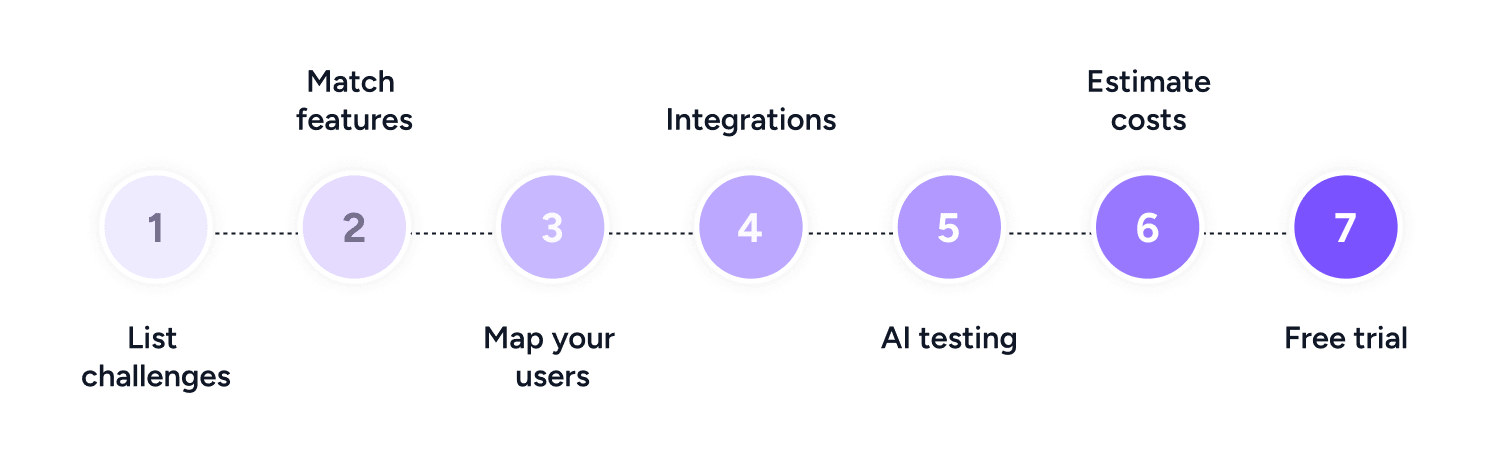
Here are seven steps to help you choose the right PIM:
List your biggest challenges
Write down what's slowing you down today: messy spreadsheets, slow launches, wrong prices, missing images. That list is your must-have checklist.
Match features to the list
For each challenge, note the feature that fixes it: bulk editing for slow updates, completeness scoring for missing data, feed management for channel sync. Skip anything that doesn't map to a real problem.
Map who will use it
The more people, and the less technical they are, the more you need an easy interface and no IT dependency. Bigger, technical teams can put roles, workflows, and permissions to use.
Ask about your exact integrations
Hand each vendor your real stack, ecommerce platform, ERP, and channels, and ask what connects natively versus what needs custom work. Get it in writing.
Test the AI features
Ask to see it enrich, translate, and clean product data, and check whether it's included or a paid add-on.
Estimate today's costs
Go past the subscription fees. Count the hours your team spends fixing and reformatting data, the revenue lost to wrong prices or missing images, and the tools a PIM would let you drop. That total is your baseline.
Try before you buy
A free trial or demo (if the PIM provider offers one) shows how much time and money a PIM actually saves, so you can prove the value before you commit.
The bottom line
There's no universal best product information management software, but for most growing and mid-market commerce brands, Plytix is the strongest fit: enterprise-grade PIM, DAM, and feeds, free AI, and native Shopify workflows, without the enterprise cost or setup. If you're running a massive catalog with dedicated IT and heavy governance needs, the enterprise platforms are built for that. Everyone else can be up and running in days.

Frequently Asked Questions
The best Akeneo alternative depends on your size and needs. For growing and mid-market brands that want enterprise-grade capability without the cost, complexity, or long setup, Plytix is the top choice. Teams needing open-source flexibility often look at Pimcore, and those focused on retailer syndication consider Salsify.
Plytix is the best PIM for Shopify. It offers native bulk editing, completeness scoring, and channel sync built specifically for Shopify, so ecommerce teams can push product data live without middleware or developer support. Enterprise PIMs like Akeneo and Salsify are built for retailer syndication, so Shopify usually means custom connector work.
Plytix is the best PIM with built-in DAM for growing and mid-market teams. PIM and DAM come in one platform, on one contract, with no separate tool to buy or bolt on. Most enterprise PIMs offer asset management too, including Pimberly, Pimcore, Akeneo, and Catsy, but usually as part of a larger enterprise setup. Kontainer is the strongest option if video is central to how you sell.
Catsy is the best PIM for B2B manufacturers with spec-driven catalogs and print production needs. For manufacturers running SAP or another enterprise ERP, Inriver goes deeper on integration. Growing B2B brands that want distributor catalogs without enterprise cost or setup usually land on Plytix.
The best free options are Plytix, which offers a free plan, and Pimcore, whose open-source community edition is free to self-host. Plytix suits non-technical teams that want to start fast, while Pimcore fits developers who want full control.
PIM pricing varies widely. Tools built for growing and mid-market teams, like Plytix, start around €499 per month with a free plan available. All while enterprise platforms such as Akeneo, Salsify, and Syndigo use custom quotes that often run into tens of thousands per year. Most enterprise vendors don’t publish pricing, so you’ll need to request a demo.