Ask a design engineer what product data management means, and you'll hear about CAD files and revision control. Ask an ecommerce manager, and you'll hear about product titles and Amazon templates. They both deal with product data. But only one of them is talking about PDM.
This article covers what PDM is, what it does well, where it stops, and how it compares to PLM and PIM. If you sell products online, that last part is the one that matters most.
What is product data management (PDM)?
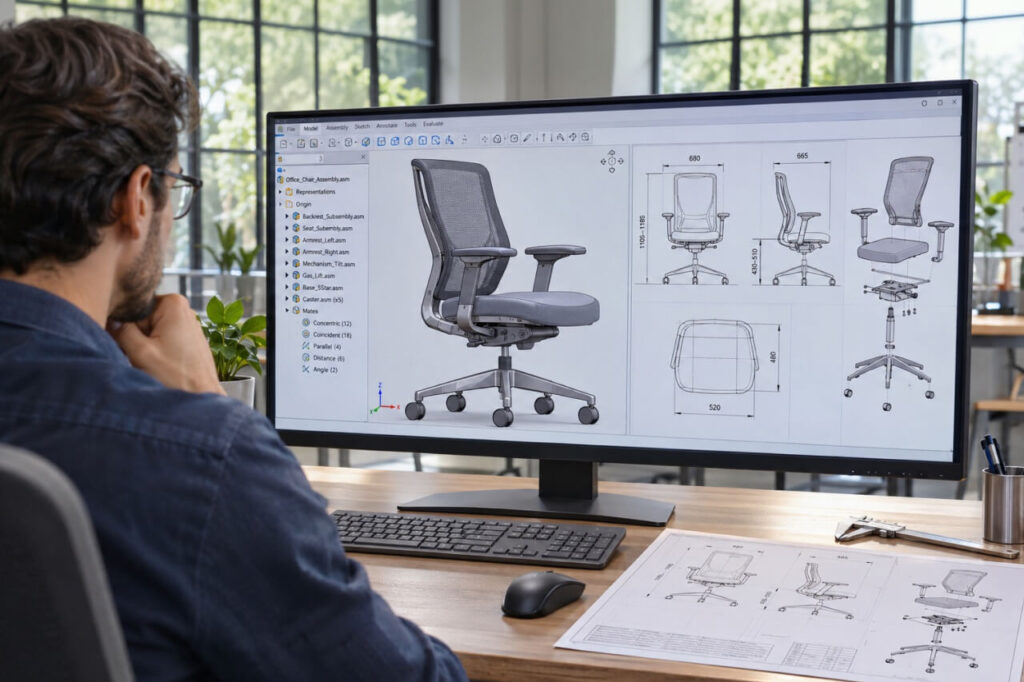
Product data management (PDM) is software that stores, controls, and tracks a product's engineering data in one central place. That includes CAD models, technical drawings, specifications, and bills of materials (BOMs). PDM keeps every file current, tracks every revision, and controls who can change what.
The idea grew out of the CAD industry. As TechTarget explains, PDM started as a way to track CAD drawings once design work moved onto computers. Today, PDM is either a standalone tool for engineering teams or a core part of a larger PLM system.
What counts as product data?
Product data covers everything you need to design, build, manage, and sell a product. It falls into four rough groups, and a different team usually owns each one.
| Type of product data | Examples | Usually owned by |
|---|---|---|
| Technical data | Dimensions, materials, CAD models, BOMs | Engineering |
| Operational data | SKUs, cost, stock levels, supplier details | Operations and finance |
| Marketing data | Titles, descriptions, key features, SEO keywords, translations | Marketing and ecommerce |
| Digital assets | Product images, videos, spec sheets, manuals | Marketing and design |
Of the four, PDM focuses on technical data. The ERP usually handles operational data, and a PIM, often with built-in DAM, manages marketing content and digital assets.
How a PDM system works
A PDM system sits next to your design tools and keeps engineering files under control. Most systems share a few core features:
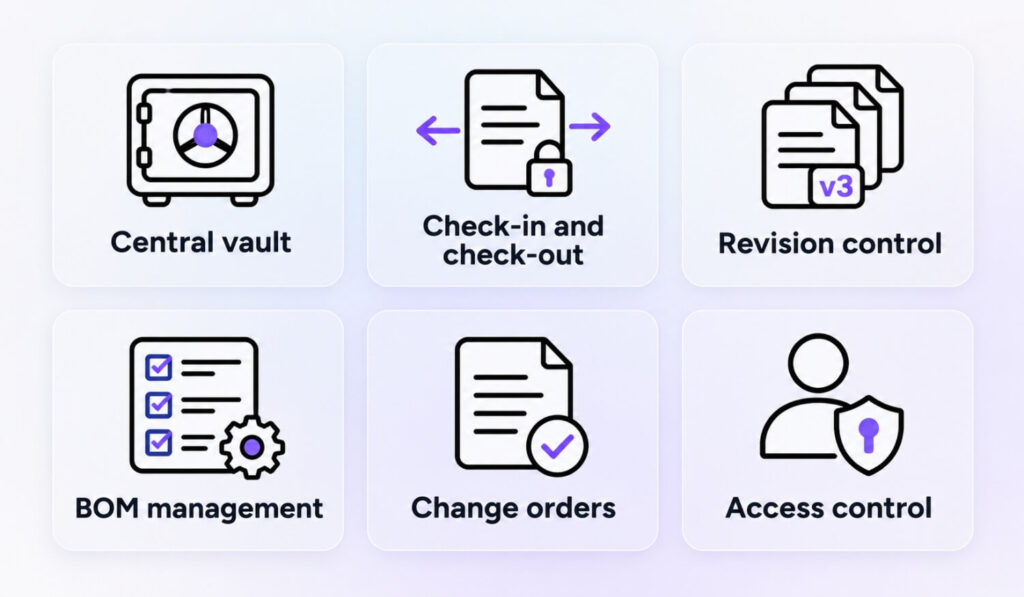
- Central vault: Every CAD file, drawing, and spec lives in one place instead of on local drives.
- Check-in and check-out: Checking out a file locks it while one person edits, so nobody overwrites anyone else’s work. Checking it back in saves the new version.
- Revision control: Every revision is tracked, so teams can see what changed and pull up earlier versions.
- BOM management: The parts list for each product stays linked to its design.
- Change orders: Engineering changes go through a formal review before they’re approved.
- Access control: Permissions decide who can view or edit each file.
Who uses PDM?
Design engineers and CAD designers use it most. Other teams, like operations, sometimes look up drawings or specs there, but they don't manage sales content in it. Common PDM tools include SOLIDWORKS PDM and Autodesk Vault.
Benefits of product data management
PDM's biggest payoff is control over engineering data. Here's what that looks like in practice:
- The latest file, every time. No more hunting for “final_v3_REAL.dwg.” Because every file lives in one vault, everyone opens the current approved version.
- Fewer costly mistakes. Revision control helps keep the factory from building to an outdated drawing.
- Faster collaboration. Teams in different locations can work on the same assembly, each on their own parts, without emailing files back and forth.
- More part reuse. Engineers can find existing parts instead of designing them again.
- A clear audit trail. Every change shows who made it and when. That matters a lot in regulated industries like medical devices and aerospace.
- Protected intellectual property. Product designs are valuable IP. A central vault and access control reduce the risk of files leaking through email attachments and USB drives.
Where PDM stops
PDM does one job very well. It controls engineering data, but it was never built to sell a product.
Once a product is designed and released, a different set of questions shows up:
- What should the title say on Amazon, and what should it say on your own store?
- Which images go to which retailer, and at what size?
- Who translates the description into German and French?
- How do you update 300 product pages when one spec changes?
But PDM isn't built to answer them. It doesn't hold marketing copy, channel-specific attributes, translations, or retailer templates. So teams fill the gap with spreadsheets, shared drives, and endless copy and paste.
Even the technical specs engineering signs off on can get stuck on the way to customers. At Variohm, a manufacturer of sensors for aerospace, defense, and medical devices, every product needed a spec sheet for buyers, but the data behind those sheets was spread across several systems.
"One product sheet went through 14 revisions before it was signed off!"
—James Ellis, Head of Group Marketing at Variohm
That gap can cost you sales. In Baymard Institute's usability testing, shoppers who couldn't find the details they needed either moved on to another product or made wrong assumptions, which led to unnecessary returns. Accurate specs only pay off if they reach the product page intact.
That's the gap a PIM fills. To see why, it helps to know how PDM, PLM, and PIM split the work.
PDM vs PLM vs PIM
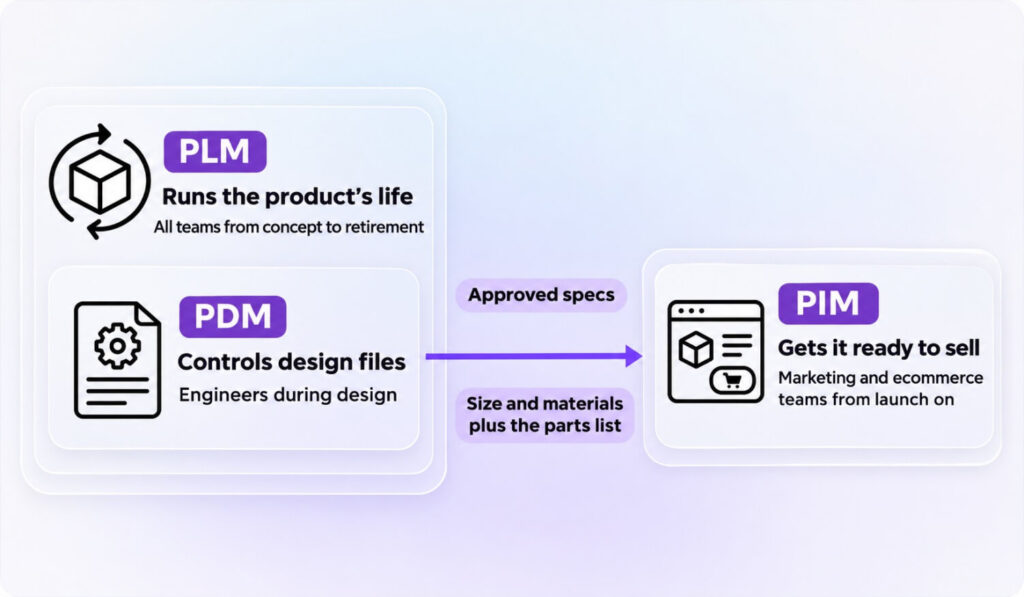
These three get mixed up all the time, partly because they all manage "product" something. Here's the short version.
| PDM | PLM | PIM | |
|---|---|---|---|
| Stands for | Product data management | Product lifecycle management | Product information management |
| Main job | Control engineering data | Manage a product from concept to retirement | Centralize, optimize, and distribute product content to every sales channel |
| Main users | Engineers and designers | Engineering, product, manufacturing, and quality teams | Marketing, ecommerce, sales, and IT teams |
| Typical data | CAD files, drawings, BOMs, revisions | Requirements, designs, BOMs, change processes, compliance | Titles, descriptions, attributes, images, translations |
| Lifecycle stage | Design and development | Concept to end of life | Launch and ongoing sales |
| Example tools | SOLIDWORKS PDM, Autodesk Vault | Siemens Teamcenter, PTC Windchill | Plytix |
What's the difference between PDM and PLM?
PDM is a subset of PLM. PDM manages engineering data during design and development, while PLM covers the whole product lifecycle, from first concept to retirement, and connects engineering with manufacturing, quality, and suppliers. Autodesk breaks down the difference in more detail. The research firm CIMdata defines PLM as a strategic business approach, not a single piece of software.
Is PDM the same as PLM?
No. They overlap, but they aren't interchangeable. As SOLIDWORKS puts it, most PLM systems are built on top of PDM features. But PLM also runs processes that reach beyond engineering, like supplier collaboration, compliance tracking, and company-wide change workflows.
Can PDM exist without PLM?
Yes. Many small and midsize manufacturers run PDM on its own. Siemens describes a common path: a mid-sized manufacturer starts with standalone PDM and adds PLM later, once its processes get more complex.
What's the difference between PDM and PIM?
PDM manages the files that define how a product is built. A PIM manages the content that sells it. Engineers use PDM to control CAD files and revisions, and marketing and ecommerce teams use a PIM to turn those specs into product pages. Gartner defines the PIM market as software that helps product, commerce, and marketing teams create and maintain an approved, shareable version of rich product content. For the full picture, see this guide to product information management and the main benefits of a PIM.
A PIM also works alongside a few other systems you'll hear about: DAM for digital assets, MDM for company-wide master data, and PXM for the wider product experience. See PIM vs. DAM and PIM vs. PXM for how those compare.
What's the difference between PIM and PLM?
PLM manages a product's development. A PIM takes over when it's time to sell. Once a design is final, PLM releases a finished product definition. A PIM picks it up, adds marketing content, and sends it to your sales channels.
Do you need both PIM and PLM?
Yes, you usually will need both if you design your own products and sell across several channels. You'll need PDM or PLM for engineering data and a PIM for the content you sell with. Smaller manufacturers can often get by with standalone PDM on the engineering side. But if you resell or white-label products, you probably don't need PDM or PLM at all. You'll still need one place for catalog management and sales content, and that's a PIM's job.
How PIM picks up where PDM stops
Follow one office chair as it moves from engineering files in PDM to a product page shoppers can buy from.
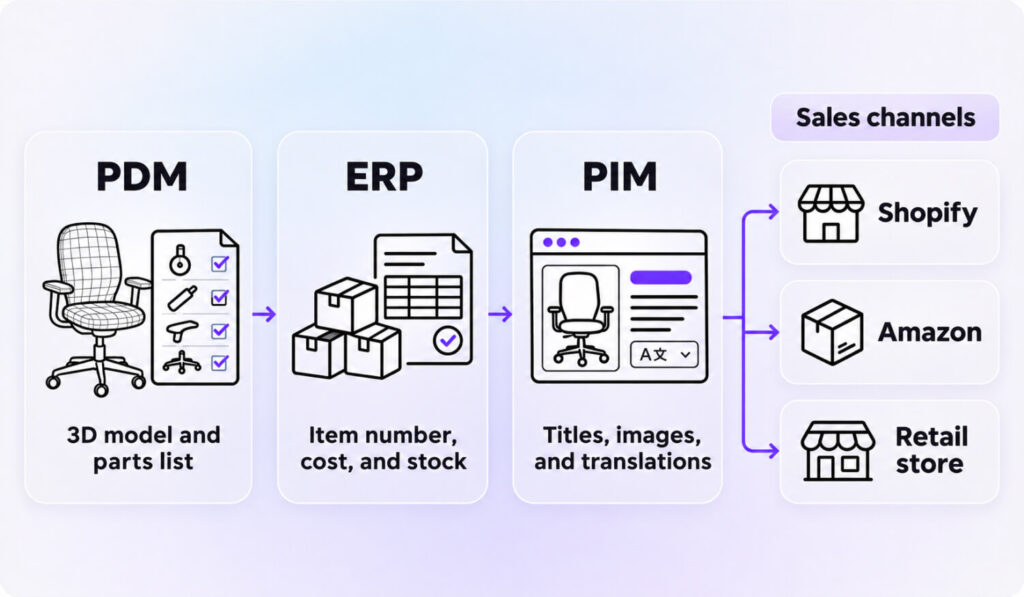
- Engineering designs the chair in CAD, and PDM manages the files. The 3D model, technical drawings, and a 23-part bill of materials live here. Revision C is approved and released.
- Operations sets it up in the ERP. The chair gets an item number, a cost, stock levels, and a manufacturing BOM. As Arena explains, the ERP uses the released BOM and item master to plan and build the product. It’s the system of record for operations, not for product content. See where ERP ends and PIM begins.
- The PIM turns it into something you can sell. Specs like dimensions and materials come in from engineering and the ERP. Marketing then adds the title, description, and key features. Images get linked to the chair and to each color variant. Translations and channel-specific attributes get filled in.
- The PIM sends it everywhere you sell. Your Shopify store, Amazon, and your retail partners each get the format they need, all from one record.
- Changes happen once. When engineering releases revision D with a new armrest, the updated specs flow into the PIM. From there, every connected channel gets the latest version.
A note on setup: links between PDM, PLM, or ERP systems and a PIM are usually scheduled file imports or an API integration, not a one-click connector. Plan the integration early, so updates flow without anyone retyping them.
Plytix: the PIM that picks up where PDM stops
Plytix is a PIM, not a PDM. It gives growing brands, manufacturers, distributors, and retailers one place to manage their product content. PIM, DAM, AI content tools, and feed management all live in one platform, so titles, specs, and images stay accurate and reach every channel in the right format.
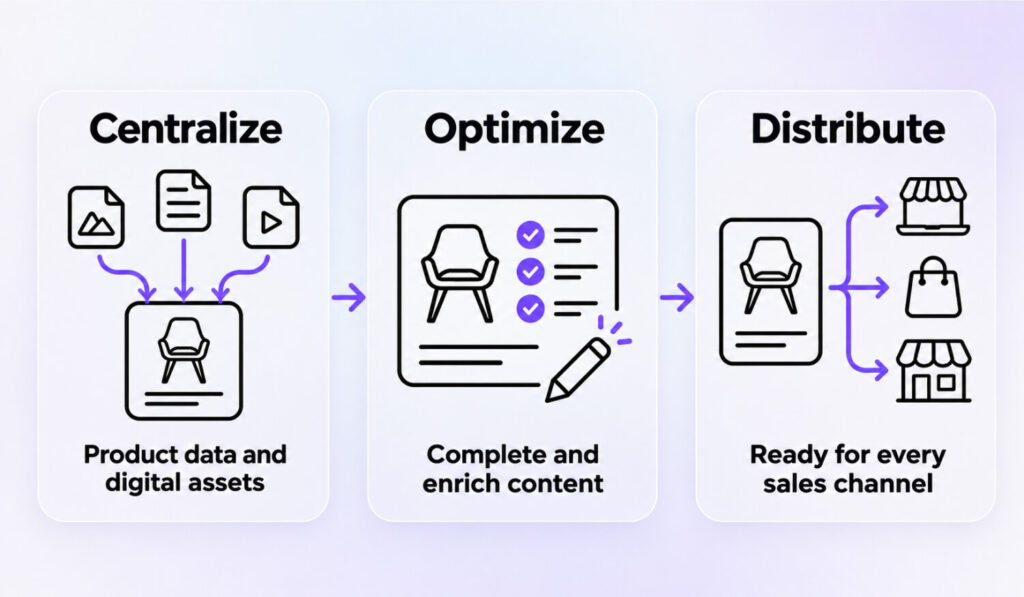
- Centralize: Product data and digital assets live in one platform. Images, videos, and documents link directly to each product, so you always know which files belong to which SKU.
- Optimize: Completeness tracking flags missing data, image transformations resize images for each channel, and Plytix AI polishes your copy, so enrichment doesn’t eat your whole week.
- Distribute: Plytix sends out channel-ready product data to the places you sell all from one system of record.
Where the CAD file ends and the product page begins
Product data management keeps engineering data under control: the CAD files, drawings, and bills of materials that define how a product gets made. It does that job well. But once a product is ready to sell, the work shifts to titles, images, translations, and channel requirements, and that's a different system's job.
PLM widens the engineering view across the whole product lifecycle. A PIM takes the finished product and turns it into content every sales channel can use. Most manufacturers that sell online end up needing both.
The ERP sits in the middle, handling cost, stock, and orders, but it isn't built for product content either. If your team is copying specs from engineering files into spreadsheets, rewriting the same description for every channel, or fixing product pages after customers complain, that's the gap a PIM closes.
Your engineers keep their PDM. But it’s the PIMs (like Plytix) that take what they designed and get it ready to sell on every channel.
Getting the product made is one step. Getting it ready for every sales channel is another.
Frequently Asked Questions
PDM stands for product data management. It refers to the processes and software used to store, organize, and control engineering data, like CAD files, technical drawings, and bills of materials.
Engineering teams use PDM software to store CAD files, control revisions, manage bills of materials, and approve design changes. It keeps everyone working from the latest approved version of every part and drawing.
No. They serve different teams and hold different data. PDM controls engineering files for designers and engineers. A PIM manages customer-facing product content for marketing and ecommerce teams. Many manufacturers use both.
Yes, you usually do if you sell across more than one channel. An ERP runs operations like inventory, orders, and cost. It isn’t built to hold rich product content like long descriptions, images, translations, and channel-specific attributes. A PIM holds that content and sends it to each channel in the format it needs.
Common PDM tools include SOLIDWORKS PDM and Autodesk Vault. PLM suites like Siemens Teamcenter and PTC Windchill include PDM features too. For PIM, Plytix helps growing brands, manufacturers, distributors, and retailers manage and distribute product content.