
Many people searching for free PIM software want open source: a PIM they can download, own, and never pay a license for. Others want a hosted plan they can start using today, without a budget conversation. Both are free to start, but they look very different once your catalog and team grow.
Every option in this guide costs $0 to start. Which one fits depends on what you want to do now and where you're headed. This guide compares the best free PIM software, what each one costs to run, and who each one suits. We checked every limit and price on each vendor's own site on November 12, 2026.
Is there free PIM software?
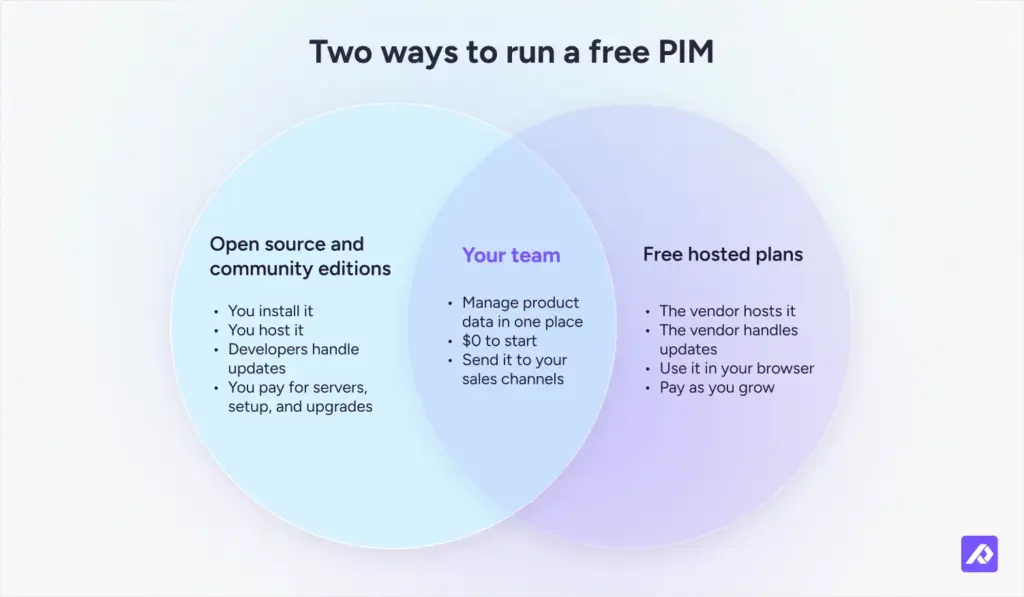
Yes. Free product information management (PIM) software comes in three kinds: open source tools, free community editions of paid products, and free hosted plans. All three cost nothing to start. The difference is who runs the software: the vendor runs a hosted plan, and your team runs open source and community editions.
A free PIM system keeps product data, like titles, attributes, prices, and images, in one place for every sales channel. With an open source PIM system, the code is public, so anyone can download it, change it, and use it for free. Open source product information management tools are sometimes called PIM freeware, since they cost nothing to download.
| Open source and community editions | Free hosted plans | |
|---|---|---|
| What it is | Free software you install and run yourself. A community edition is the free version of a paid product | A free plan of software the vendor runs for you |
| It’s like… | Building your own house | Renting a furnished apartment |
| Who runs it | Your team, developer, or agency | The vendor |
| You pay for | Servers, setup, developers, and paid upgrades | More products, users, or features as you grow, depending on the vendor |
| Examples | AtroPIM, UnoPim, OpenPIM, Akeneo Community Edition, Pimcore Community Edition | Plytix, Ergonode |
What to know before you choose free PIM software
Three things decide what a free PIM will ask of you: price vs. cost, who hosts and maintains it, and how much developer time it takes.
- Price vs. cost. Price is what’s on the price tag, and for every tool in this guide it’s $0. Cost is what you spend to use it: servers, people’s time, upgrades, and fixes.
- Hosting and maintenance. Every PIM runs on a server and needs regular updates and fixes. With a hosted plan (also called SaaS, or software as a service), the vendor handles both. With a self-hosted tool, you rent the server and keep it updated yourself.
- Developer time. Self-hosting isn’t a one-time job. A developer or agency sets it up, and then you go back to them for every upgrade, broken connection, and new sales channel. That ongoing time keeps adding to the cost for as long as you use the tool.
Best free PIM software compared
The best free PIM software is a free hosted plan like Plytix if you want to skip servers and upkeep. If you have developers who want full control of the code, choose Akeneo Community Edition. Pimcore Community Edition, AtroPIM, UnoPim, and OpenPIM suit teams ready to run the software themselves.
This table compares each product information management system, open source or hosted. It covers what matters most in a free PIM: how quickly you can get started, who keeps it running, and what it costs as you grow.
| What to check | Plytix | Ergonode | Akeneo CE | Pimcore CE | AtroPIM, UnoPim, OpenPIM |
|---|---|---|---|---|---|
| Getting started | As soon as your account is set up | As soon as your account is set up | After a developer installs it on a server | After a developer installs it on a server | After a developer installs it on a server |
| Updates and fixes | Plytix handles them | Ergonode handles them | Your developer | Your developer | Your developer |
| Free product limit | 100 SKUs | 1,000 products | None | None, under €/$5M revenue | None |
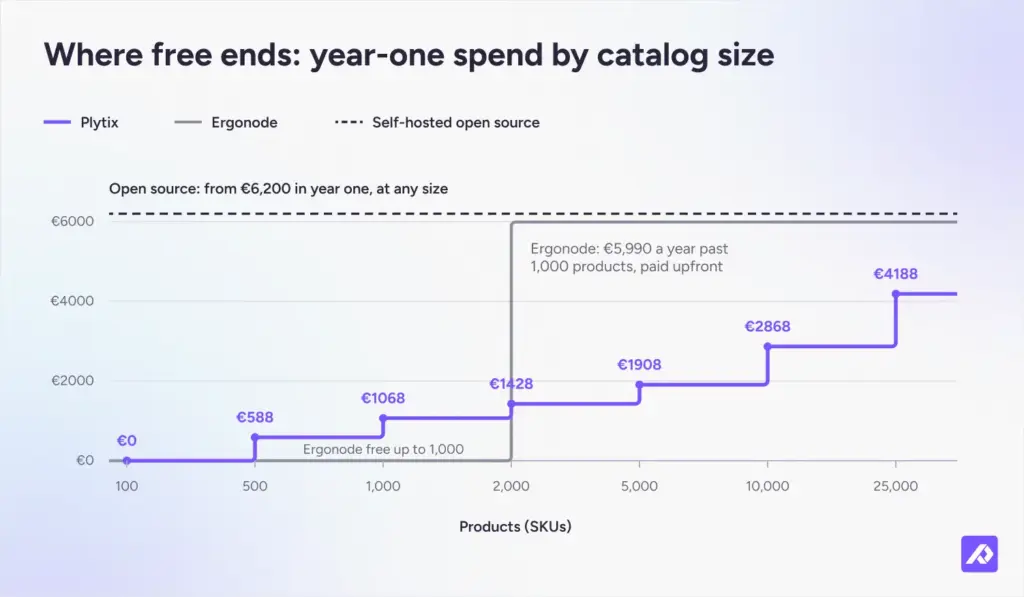
| Year-one cost at 2,000 SKUs | €1,428 (€119/month) | €5,990, paid upfront | From €6,200 in hosting and setup | From €6,200 in hosting and setup, plus a $9,900 license above €/$5M revenue | From €6,200 self-hosted, or €4,800 for AtroPIM's hosted edition |
| Users | Unlimited | Two (20 on the €5,990 plan) | Unlimited | Unlimited | Unlimited |
| File storage | Unlimited, with DAM built in | 2 GB | Your server's space | Your server's space, DAM included | Your server's space |
| Support | Plytix team | Community (Slack) | Community and partners | Community, or with a paid license | Community |
Which free PIM fits your team?
The right free PIM depends on your catalog size, your team, and who will run the software. If you want to try features and grow as you go, Plytix lets you test every add-on and pay in small steps as your catalog grows. If you only need around 1,000 products and a couple of users, Ergonode Free covers that, but the price jumps sharply once you grow past it. If you already have the infrastructure and developers in place, open source can work. Plan for the time it takes to rely on developers or partners for every change and security update.
| If you want to… | Best free fit | Keep in mind |
|---|---|---|
| Try the features on your own data and grow as you go | Plytix | Free up to 100 SKUs with every add-on. Paid plans go up in small steps, starting at €49/month for 500 SKUs |
| Run a small catalog of about 1,000 products with one or two users | Ergonode Free | The next plan is €5,990 a year, paid upfront |
| Own and customize the software, with developers and hosting in place | Akeneo, Pimcore, AtroPIM, UnoPim, or OpenPIM | Every change, fix, and security update depends on your developers or partner |
For a closer look at the tradeoffs, read our guide to open source vs. SaaS PIM.
What does a free PIM cost as you grow?
The real cost of a free PIM depends on three things: what you pay now, what happens to the price as you grow, and how much of your team's time it takes to run.
- What you pay now. Every option in this guide costs $0 to start.
- What happens when you grow. Some PIMs grow in small steps with your catalog. Others jump to a much higher plan once you pass the free limit. Paying for features or seats you don’t use is one of the reasons teams look at switching PIMs.
- What it costs in time. With open source, you rely on developers or partners for every change, fix, and security update. Plytix’s PIM pricing guide estimates $6,200 to $26,000 for hosting and setup in the first year alone.
See what your catalog would cost on Plytix.
The best free and open source PIM tools
The best free and open source PIM software options fall into three groups, from free hosted plans to open source PIM solutions. Plytix and Ergonode offer free hosted plans. Akeneo Community Edition and Pimcore Community Edition are community editions, and AtroPIM, UnoPim, and OpenPIM are open source. Pros and cons below come from G2 reviews where a tool has enough of them.
Plytix (free plan)
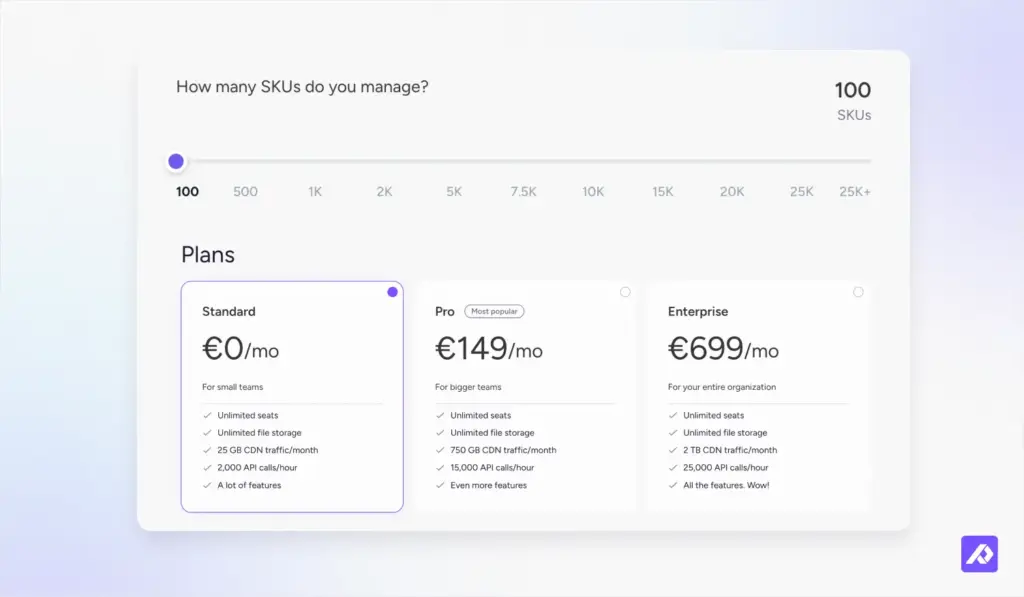
Plytix is a hosted PIM built for ecommerce and marketing teams that want to move fast, from SMB and mid-market brands to teams within larger companies. Its Standard plan starts at $0 a month for 100 SKUs, and you can start adding products as soon as your account is set up.
Pros
- Easy to use, with an interface reviewers call intuitive
- Helpful, consistent customer support
- Feature-rich, with new features added often
Cons
- Fewer customization options than some teams want
- Some features, like reporting, are limited
What stands out
- Ranked first among free PIM systems on G2, with a 4.7 out of 5 rating from 452 reviews (G2, November 2026)
- Unlimited users and file storage, and every add-on free to try
- Pricing that grows in small steps by SKU count, billed monthly
Paid pricing starts at $49 a month for 500 SKUs and grows in small steps, and Pro comes with a 14-day free trial.
Ergonode (free plan)
Ergonode's Free plan is a hosted PIM for up to 1,000 products and two users. It suits one or two people with a small catalog that won't grow much.
Pros
- User-friendly interface
- Flexible for managing product information
Cons
- Setup and data migration can take a lot of staff time
- A steep learning curve for non-technical team members
- A jump to €5,990 a year, paid upfront, once you need more than two users or 1,000 products
What stands out
- The highest product limit of the free hosted plans here, at 1,000 products
Akeneo Community Edition
Akeneo Community Edition is one of the most established open source PIMs. It suits teams with developers who want a proven PIM they can customize. To see how it compares with a hosted PIM, read Plytix vs. Akeneo.
Pros
- Strong core PIM features
- Good integrations and API connections
Cons
- Complex initial setup that needs technical expertise
- A steep learning curve
- You host it, and since Akeneo only fixes its newest release, someone has to upgrade it every few months
What stands out
- More than 100 connectors and extensions built by its community
Pimcore Community Edition
Pimcore Community Edition suits developer teams building a wider data platform. It's free for companies under €5 million or $5 million in yearly revenue.
Pros
- PIM, DAM, and master data management (MDM) in one platform
- Highly customizable
Cons
- A steep learning curve
- Changes often depend on developers or integrators
- Above the revenue limit, a paid license starts at $9,900 a year
What stands out
- One platform for many kinds of business data, not just products
AtroPIM
AtroPIM is open source and suits teams that want to self-host now, with the option of paid hosting later. It has a 4.9 out of 5 rating from six reviews on G2.
Pros
- Built API-first, so suppliers and systems can feed data in directly
- Runs on your own server or in the cloud
Cons
- Self-hosting needs a developer
- Configuring complex integrations requires scripting
- A learning curve for people new to data modeling
What stands out
- A hosted edition from €400 a month if you later want someone else to run it
UnoPim
UnoPim is open source and suits teams whose developers already build in PHP.
Pros
- AI tools for content, images, and translation
- Popular on GitHub, with about 11,000 stars
Cons
- It needs a developer to host
- Scheduled Shopify exports need a paid connector
What stands out
- A managed cloud option if you’d rather not host it yourself
OpenPIM
OpenPIM is open source and suits small technical teams that want a simple PIM to try.
Pros
- Every feature is free
- Runs on your own server or any cloud server
Cons
- A small community
- No dated releases on GitHub, so check recent activity before you move your catalog into it
What stands out
- The only tool here with no paid version at all
Can't we just build our own PIM with AI?
You can build a first version with AI, but a PIM is your system of record, so it has to stay accurate every day after that. AI-written code and AI edits can make mistakes, and a homegrown PIM leaves you to catch them.
- Checks that stop incomplete or wrong products from going live
- History and undo when a bulk change goes wrong
- Upkeep as channels change their rules and the person who built it moves on
A ready-made PIM already handles this, so your developers can focus on work that sets your business apart.
Is free PIM software worth trying?
Yes, as long as you pick one that fits where your catalog and team are headed. Free PIM software is a good way to get your products out of spreadsheets without a budget conversation.
Start on Plytix for free with up to 100 SKUs and every add-on, and see how your own product data looks in a PIM. If you're also comparing paid options, our guide to the best PIM software puts them side by side.
Frequently Asked Questions
Yes. Plytix offers a 14-day free trial of its Pro and Enterprise plans, and its Standard plan is free for up to 100 SKUs with no time limit. Many PIMs, including some listed as free on review sites, offer a free trial rather than a plan that stays free.
For most small businesses, a free hosted plan is the best free product information management software to start with, because there’s nothing to install or maintain. Plytix’s Standard plan is free for up to 100 SKUs with unlimited users, and Ergonode’s Free plan covers up to 1,000 products for two users. If you want to run it yourself, Akeneo Community Edition is one of the most established open source options.
There’s no catch. Plytix’s mission is to make enterprise-grade product information management available to businesses of every size, not just companies with enterprise budgets. Paying for features or seats you don’t use is one of the reasons teams look at switching PIMs. That’s why Plytix pricing is published, grows in small steps with your SKU count, and never charges per user. Read more about our mission, or see what users say on G2.